
A denied insurance claim is not merely bad luck; it is often a failure of documentation.
- Routine tasks must be recorded with dated photos and receipts to construct a verifiable audit trail.
- Professional service reports need to detail specific readings and findings, not just a generic “System OK,” to serve as valid proof of thoroughness.
Recommendation: Shift your mindset from simply performing maintenance to systematically proving due diligence with an irrefutable dossier of evidence.
Imagine the frustration: a pipe bursts or a fire starts, you file an insurance claim, and it’s denied for “gradual wear and tear” or “lack of maintenance.” You know you’ve taken care of your home, but can you prove it to an auditor’s satisfaction? In the systematic world of insurance, the burden of proof rests entirely on you, the homeowner. An undocumented task is, from an auditor’s perspective, a task that was never performed.
Most homeowners believe keeping a folder of receipts or occasionally cleaning the gutters is sufficient. They might even take a photo here and there. But this approach is often inadequate. An auditor is not looking for good intentions; they are looking for a consistent, verifiable, and dated record of due diligence. They are trained to spot gaps in an evidence trail that point toward negligence, which is a common basis for claim denial.
The key to protecting your investment isn’t just about performing more chores. It’s about building a systematic, irrefutable dossier of evidence that serves as a legal shield against negligence-based exclusions. This guide reframes routine home maintenance not as a series of tasks, but as the meticulous process of creating an auditor-proof record. We will approach this from the viewpoint of the person who will ultimately scrutinize your actions: the auditor.
Throughout this article, we will dissect the critical maintenance tasks for key home systems. More importantly, we will detail the specific documentation methods that transform your diligent efforts from simple actions into undeniable proof of care. This is your blueprint for creating a maintenance log that stands up to scrutiny.
Summary: Build a Maintenance Schedule That Satisfies Insurance Auditors
- Sediment Build-Up: Why Flushing Your Tank Annualy Extends Life?
- The Fire Hazard Hidden Behind Your Dryer: How to Clean It Safely?
- Stain or Paint: Which Maintenance Protects Wood Decks from Rot?
- The Septic Failure That Insurance Calls “Lack of Maintenance”
- Furnace Filters: How Dirty Filters Lead to Claims Denials?
- The Furnace Check-Up That Saves You from a “Lack of Maintenance” Denial
- How to Prove You Performed Maintenance When a Leak Is Discovered?
- Why Skipping Routine Inspections Can Void Your Water Damage Claim?
Sediment Build-Up: Why Flushing Your Tank Annualy Extends Life?
The water heater is a silent workhorse, but its failure is often catastrophic, leading to significant water damage. From an auditor’s perspective, a rusted-out tank is a classic sign of neglect. Mineral sediment, present in most water supplies, settles at the bottom of the tank. Over time, this layer insulates the water from the heating element, causing it to overheat and corrode the tank’s steel lining. This is not considered “sudden” damage; it’s a gradual failure that routine maintenance could have prevented.
Insurance providers are clear on this point. Any damage from failing to flush sediment, ignoring small leaks, or not replacing the anode rod leads to maintenance-related claim denials. The anode rod is a particularly crucial piece of evidence. It’s a “sacrificial” component designed to attract corrosive minerals, protecting the tank itself. A disintegrated rod with no record of replacement is a red flag for an auditor.
To build your evidence dossier, annual flushing is non-negotiable. When you perform this task, document the “before” (murky, sediment-filled water) and “after” (clear water) with dated photographs. Keep receipts for any tools purchased, like a drain hose or a new anode rod. A log entry should read: “Annual water heater flush completed on [Date]. Anode rod inspected, condition noted. See attached photos and receipt for [Product].” This creates a clear, time-stamped record of proactive maintenance, directly countering any claims of negligence.
The Fire Hazard Hidden Behind Your Dryer: How to Clean It Safely?
A clogged dryer vent is one of the most significant and preventable fire hazards in a home. Lint, being highly combustible, accumulates in the vent duct with every cycle. As airflow becomes restricted, the dryer overheats, and this lint can easily ignite. For an insurance auditor investigating a fire claim, a lint-packed dryer vent is a clear indication of a “failure to clean,” a form of negligence that can void coverage. The statistics are stark: nearly 2,900 home dryer fires occur annually, causing over $35 million in property damage, with 34% resulting from a failure to clean.
Safely cleaning the vent requires disconnecting the dryer, using a specialized brush to clear the entire length of the duct—from the dryer to the exterior vent cap—and vacuuming up all debris. Merely cleaning the lint trap inside the dryer is not sufficient; the entire vent path must be clear. This is the standard an auditor will expect.
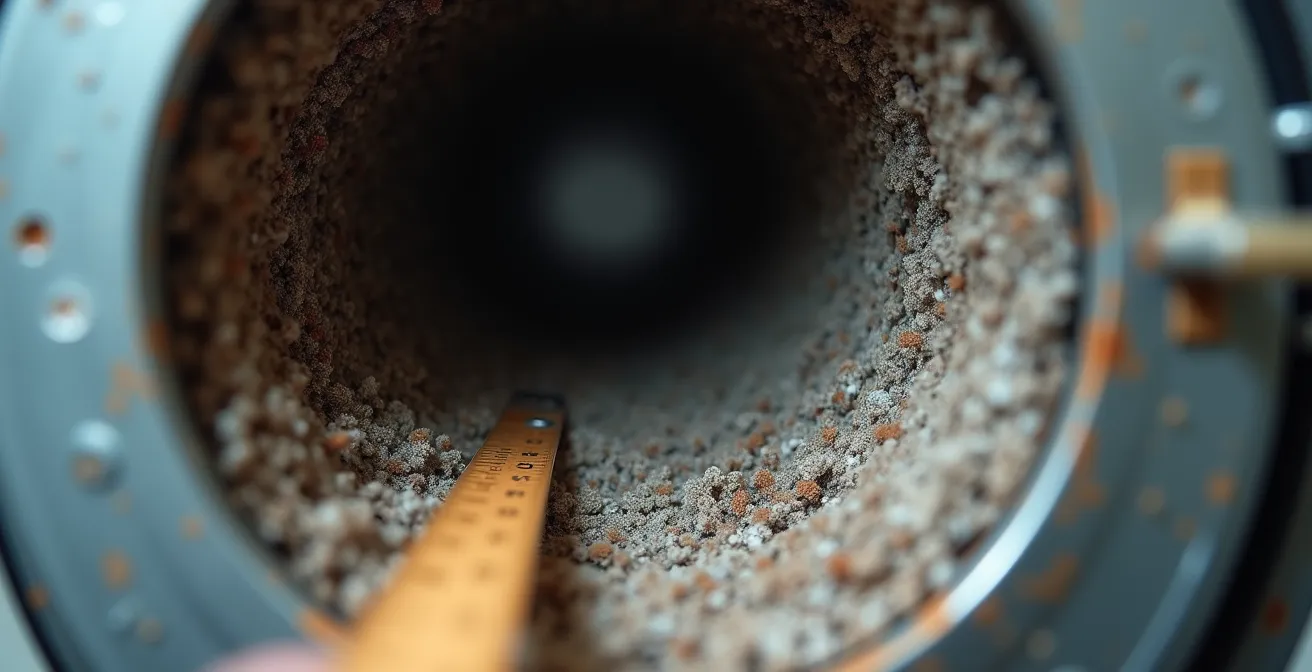
Documenting this task is straightforward. Take a “before” photo of the lint buildup at the exterior vent and an “after” photo showing it’s clear. For a more robust evidence file, especially for long or complex vent runs, hiring a professional is a wise investment.
Case Study: Professional Documentation as a Shield
Insurance companies can and do deny fire claims due to poorly maintained dryer vents. To preempt this, homeowners can hire a professional service that provides a detailed receipt of work. This documentation should include not just the cleaning service but also airflow measurements taken before and after the service. A receipt showing that airflow was restored to safe, manufacturer-specified levels is powerful evidence against a negligence claim, particularly for vents longer than 25 feet or with multiple bends, where self-cleaning is less effective.
Stain or Paint: Which Maintenance Protects Wood Decks from Rot?
A wood deck is a structural extension of your home, and its failure can lead to property damage and liability claims. Auditors are trained to look for signs of rot, particularly at critical connection points like the ledger board (where the deck attaches to the house) and post bases. The primary cause of rot is trapped moisture, which is often exacerbated by improper maintenance choices.
While both paint and stain offer a protective coating, their mechanisms differ significantly. Paint forms a film on the surface of the wood. While initially effective, this film can crack or peel, allowing water to seep underneath. Once trapped, the moisture cannot escape, creating an ideal environment for rot. From an auditor’s viewpoint, a peeling paint job is a direct contributor to wood decay. In contrast, a penetrating oil-based stain soaks into the wood fibers, repelling water from within without creating a film that can trap moisture. This is the preferred method for long-term structural health.
Your maintenance log should reflect this informed choice. Annually, you should conduct and document a structural inspection. Check for a secure ledger board, stable posts, and secure railings. Photograph these key structural elements. When applying a protective coat, document the product used. Keep the product label or receipt and note in your log: “Applied [Product Name], a penetrating oil stain, on [Date]. See attached photos of structural points and product receipt.” This demonstrates not just that you performed maintenance, but that you used the appropriate materials to prevent gradual damage, a key point in any insurance review.
The Septic Failure That Insurance Calls “Lack of Maintenance”
A septic system failure is a homeowner’s nightmare, resulting in costly cleanup and potential denial of insurance coverage. Standard home insurance policies explicitly exclude damage caused by water backing up from sewers or drains unless a specific endorsement is purchased. Even with an endorsement, a claim can be denied if the failure is attributed to homeowner negligence. An overloaded or unpumped tank that leads to a drain field failure is the textbook definition of a preventable, maintenance-related issue.
To an auditor, a claim of “we didn’t know” is not a defense. Insurance companies require homeowners to perform routine maintenance to keep coverage eligibility, and the septic system is a prime example. Simply having a receipt for pumping every few years is not enough. A comprehensive evidence dossier must show a holistic approach to system management.
This involves documenting household practices (e.g., use of septic-safe cleaners, items not flushed), obtaining detailed system health reports from septic professionals—not just pumping receipts—and scheduling comprehensive inspections every 3-5 years. A diagram of your system’s layout is also a valuable part of your records. This level of detail proves you are an active, knowledgeable manager of your system, not a passive owner waiting for a disaster.
Action Plan: Septic System Documentation for Insurance Audits
- Obtain and file comprehensive system health reports from your septic company, detailing tank and drain field condition, not just pumping records.
- Create or acquire a detailed diagram showing the location of the tank, distribution box, lines, and drain field for your property records.
- Document your household’s septic-safe practices, including the specific cleaners used and a list of items prohibited from being flushed.
- Schedule and document professional inspections every 3-5 years, ensuring you receive detailed written reports on the system’s condition.
- Maintain a dedicated digital maintenance folder with time-stamped copies of all receipts, inspection reports, and communication with service providers.
Furnace Filters: How Dirty Filters Lead to Claims Denials?
The simple furnace filter is a component that auditors frequently check as an indicator of routine maintenance. A dirty, clogged filter does more than just reduce air quality; it restricts airflow, forcing the furnace’s blower motor to work harder. This can lead to overheating, premature component failure, and in severe cases, a fire hazard. If a furnace failure or related damage is traced back to a chronically clogged filter, an insurance company can argue that the loss resulted from a lack of basic maintenance.
Furthermore, this simple act of maintenance has financial benefits beyond insurance compliance. Proving you perform routine HVAC upkeep can be beneficial, as well-maintained systems are more efficient. For example, some data suggests that energy-efficient HVAC maintenance can save homeowners 8-34% on energy bills, all while ensuring insurance requirements are met. Your documentation serves a dual purpose: proof of care and a record of efficiency measures.
Proving you change your filters regularly is simple but requires a systematic approach. Keeping receipts for filter purchases is a good first step, but it doesn’t prove they were installed on time. The most effective method is creating direct, visual evidence.
The “Date-on-Filter” Documentation Technique
As recommended by insurance providers like American Family Insurance, the practice of writing the installation date directly on the new filter’s frame with a permanent marker is a powerful documentation tool. After writing the date, take a quick, clear photograph of the newly installed filter in place. This action creates an undeniable, time-stamped visual record of your maintenance compliance. When you combine this photo with the receipt for the filter purchase, you establish a closed-loop evidence trail that is exceptionally difficult for an insurance auditor to dispute.
The Furnace Check-Up That Saves You from a “Lack of Maintenance” Denial
While changing filters is a fundamental homeowner task, an annual professional furnace check-up provides a higher level of documented proof. However, not all service reports are created equal. An auditor will be dismissive of a receipt that simply says “Furnace inspected, system OK.” This is a passive record. An active, defensible record contains specific, verifiable data that proves the system’s health at a particular point in time.
When you schedule a professional HVAC service, you are not just a customer; you are a manager gathering evidence. You must instruct the technician to provide a report with detailed findings. This report should include crucial metrics such as gas pressure readings, flame sensor measurements, and the results of a visual inspection of the heat exchanger. These data points provide a baseline of the system’s operational health.
Furthermore, your evidence file should include documentation of related safety systems. This means logging the dates of carbon monoxide detector testing and battery replacements. It also means ensuring the technician’s report explicitly states that the condensate line was flushed and is clear, as a clogged line can lead to significant water damage, another potential claim. By scheduling these check-ups in the off-season (e.g., spring for heating, fall for cooling), you also demonstrate proactive planning. A file containing technician reports rich with specific readings and dates is a powerful tool to refute any claim of neglect.

How to Prove You Performed Maintenance When a Leak Is Discovered?
When a water leak occurs, the immediate aftermath is stressful. The last thing you want to worry about is whether your insurance claim will be approved. The key distinction an auditor will make is whether the leak was “sudden and accidental” (typically covered) or the result of “gradual wear and tear or neglect” (typically denied). Proving you are on the right side of that line depends entirely on the quality of your pre-existing maintenance records.
This is where a modern, digital approach to your evidence dossier becomes invaluable. A cloud-based folder system (e.g., Google Drive, Dropbox) organized by home system (Plumbing, HVAC, Electrical, etc.) is an auditor’s dream. Within each folder, you should store dated photos, receipts for parts and services, and PDF copies of professional inspection reports. This centralized, organized system demonstrates a high level of diligence.
The photos themselves contain a hidden layer of proof that is extremely powerful: metadata. This technique transforms a simple picture into non-repudiable evidence.
Leveraging Photo Metadata as Irrefutable Evidence
Every photo taken with a modern smartphone contains embedded EXIF data, which includes the date, time, and often the GPS location of where the picture was taken. This data is not easily altered and serves as a digital notary. An insurance adjuster cannot easily dispute a photo of a clean, corrosion-free plumbing fixture under a sink that has a clear timestamp from two months before a leak occurred. By conducting regular visual inspections of your home and creating a “Nothing Found” log entry (e.g., “October 1, 2024: Inspected all under-sink plumbing and shut-off valves. No leaks, corrosion, or issues found. See attached photos.”), you create a powerful, time-stamped record of your due diligence that can be the deciding factor in preventing a claim denial.
Key Takeaways
- Shift from “doing” to “proving”: The goal is an irrefutable evidence dossier, not just a completed task list.
- Documentation is king: Use dated photos with EXIF data, detailed professional reports with specific readings, and organized digital folders.
- Differentiate your records: Show proactive care (e.g., using penetrating stain vs. paint) and create “nothing found” logs to establish a baseline of good condition.
Why Skipping Routine Inspections Can Void Your Water Damage Claim?
The fundamental principle of home insurance is to cover sudden, accidental, and unforeseen events. It is not designed to be a warranty against the slow, inevitable decay of a property. This is the most critical distinction for any homeowner to understand, and it is the lens through which every claim, especially for water damage, is viewed. Skipping routine inspections is tantamount to willfully ignoring the potential for gradual decay, which is a direct path to a claim denial.
An insurance auditor’s job is to categorize the damage. Was the collapsed ceiling from a pipe that burst suddenly during a freeze, or was it from a slow leak from a corroded fitting that had been staining the drywall for months? In the first scenario, a homeowner with records of proper winterization has a strong case. In the second, the lack of any inspection records that could have caught the stain early will likely lead to a denial based on neglect.
Your maintenance log serves as the primary evidence to place your claim firmly in the “sudden and accidental” category. A log entry from an annual roof inspection noting “All flashing secure, no signs of water intrusion” becomes invaluable if a severe storm later damages that same roof. Without that prior record, the insurer could argue the storm merely exacerbated pre-existing wear and tear. The following table clarifies how an insurer typically views these scenarios.
This table, based on common insurance industry practices like those outlined by providers such as Wawanesa Insurance, shows the clear advantage of having a documented maintenance history.
| Damage Type | Insurance Coverage | Documentation Required | Inspection Frequency |
|---|---|---|---|
| Sudden & Accidental | Typically Covered | Recent inspection showing no prior issues | Annual professional inspection |
| Gradual & Negligent | Usually Denied | Absence of maintenance records | No documented inspections |
| Storm-Related with Prior Inspection | Covered | Dated photos before storm | Semi-annual checks |
| Wear & Tear Without Records | Not Covered | No maintenance documentation | Never inspected |
By transforming your approach to home maintenance from a series of chores into a systematic process of evidence collection, you are no longer just a homeowner. You become the diligent archivist of your property’s health, armed with a dossier that validates your actions and protects your financial future. This meticulous record-keeping is your ultimate defense in the event of a claim.