
Leaving your home empty for an extended period transforms your insurance policy into a contract with strict, non-negotiable conditions that can automatically void your coverage if breached.
- Your policy is not for an “empty house” but for an “owner-occupied” one; vacancy is a material change in risk that must be managed.
- Simple actions like regular, documented visits and maintaining temperature are not suggestions—they are contractual obligations.
Recommendation: Before you leave, you must conduct a formal audit of your policy’s vacancy clauses and obtain written permission from your insurer for your absence.
For snowbirds and long-term travelers, the primary concern when leaving a home vacant is often security—the risk of a break-in or a burst pipe. While these are valid worries, the greatest financial threat is far more subtle and insidious: the clauses buried within your own home insurance policy. Many homeowners mistakenly believe that as long as they pay their premiums, their coverage remains intact. This is a dangerous and costly assumption. An insurance policy is a dynamic contract, one that is predicated on a specific level of risk associated with an occupied dwelling. When you leave for an extended period, you fundamentally alter that risk profile.
The common advice—have a friend check in, turn down the heat—is often dangerously incomplete. It fails to frame these actions for what they truly are: minimum requirements to fulfill your contractual obligations. Non-compliance isn’t a minor infraction; it can be grounds for an immediate and total denial of a claim, even one completely unrelated to the vacancy itself. The moment your property’s status changes in the eyes of the insurer, certain coverages can be suspended or voided entirely, often after a strict 30-day deadline.
This guide departs from simple tips. Its purpose is to function as a compliance manual, decoding the legalese of insurance contracts to safeguard your most valuable asset. We will not focus on deterring burglars, but on preventing the nullification of your policy. The core principle is this: your responsibility is not just to protect your home, but to meticulously document your adherence to the policy’s rules. This requires a shift in mindset from homeowner to risk manager, treating your absence not as a vacation from responsibility, but as a period of heightened diligence.
This article will dissect the most critical policy clauses you must adhere to. We will examine the required frequency of visits, the thermostat settings that are non-negotiable, the precise changes you are obligated to report, and the common mistakes that inadvertently change your occupancy status, leaving you uninsured. By understanding these rules, you can transform your policy from a potential liability into a reliable shield.
Summary: Guaranteeing Insurance Validity for Your Vacant Home
- Why You Must Have Someone Visit Your Empty Home Every 48 Hours?
- Renovation or Business: Which Change Must You Report Immediately?
- The Thermostat Setting That Guarantees Adherence to Freeze Clauses
- The Mistake of Letting a Friend Stay That Changes Your Occupancy Status
- The 30-Day Rule That Voids Coverage for Empty Homes
- The Visitation Log: How Often Must You Check on Your Cottage?
- Grace Period vs Cancellation: When Does Coverage Actually Stop?
- How to Find and Fix the Coverage Gaps in Your Current Policy?
Why You Must Have Someone Visit Your Empty Home Every 48 Hours?
The most fundamental requirement for maintaining your insurance during an absence is ensuring the property is regularly monitored. This is not a vague suggestion but a specific contractual obligation. An empty home is a higher risk for perils like water damage, fire, and vandalism, which can go unnoticed and escalate catastrophically. To mitigate this, insurers mandate a schedule of physical inspections. Failure to comply can be interpreted as negligence and may be grounds for denying a claim related to an undiscovered issue.
While the exact frequency can vary, most insurance policies require someone to check your vacant home every 48 to 72 hours. This person acts as your proxy, demonstrating diligence in protecting the insured asset. It is critical to understand that this is not a casual favor. The designated individual must be reliable and capable of performing a thorough check, not just picking up the mail. They are your first line of defense against both physical damage and policy non-compliance.
Simply having someone visit is not enough; you must be able to prove it in the event of a claim. This is where a formal, documented process becomes essential. The visitor should maintain a detailed log with dates, times, and observations. Taking dated photos or a short video during each visit is an increasingly common and highly recommended practice. This evidence of due diligence can be the deciding factor between a paid claim and a complete financial loss. The burden of proof rests entirely on you, the policyholder.
Renovation or Business: Which Change Must You Report Immediately?
Your standard home insurance policy is underwritten based on a precise snapshot of your property and its use at the time of purchase: a residential, owner-occupied dwelling. Any deviation from this snapshot constitutes a “material change in risk,” a term you must understand and respect. You are contractually obligated to report any such change to your insurer immediately. The two most common and often-overlooked material changes are undertaking major renovations or using the home for business purposes, even temporarily.
Starting a renovation project, especially while the home is vacant, introduces significant new risks. These include potential for water damage from new plumbing, fire from construction activities, and theft of materials or tools. Similarly, if your “house-sitter” is actually a remote worker running a business from your property, your liability exposure changes dramatically. Insurers view these scenarios differently, and failure to report them can void your coverage entirely. The insurer has the right to reassess the risk and adjust your premium—or even decline to cover the new risk. Data shows that average premium increases in 2024 show a 17.4% rise when material changes are disclosed, but this cost is insignificant compared to the financial ruin of an uncovered claim.
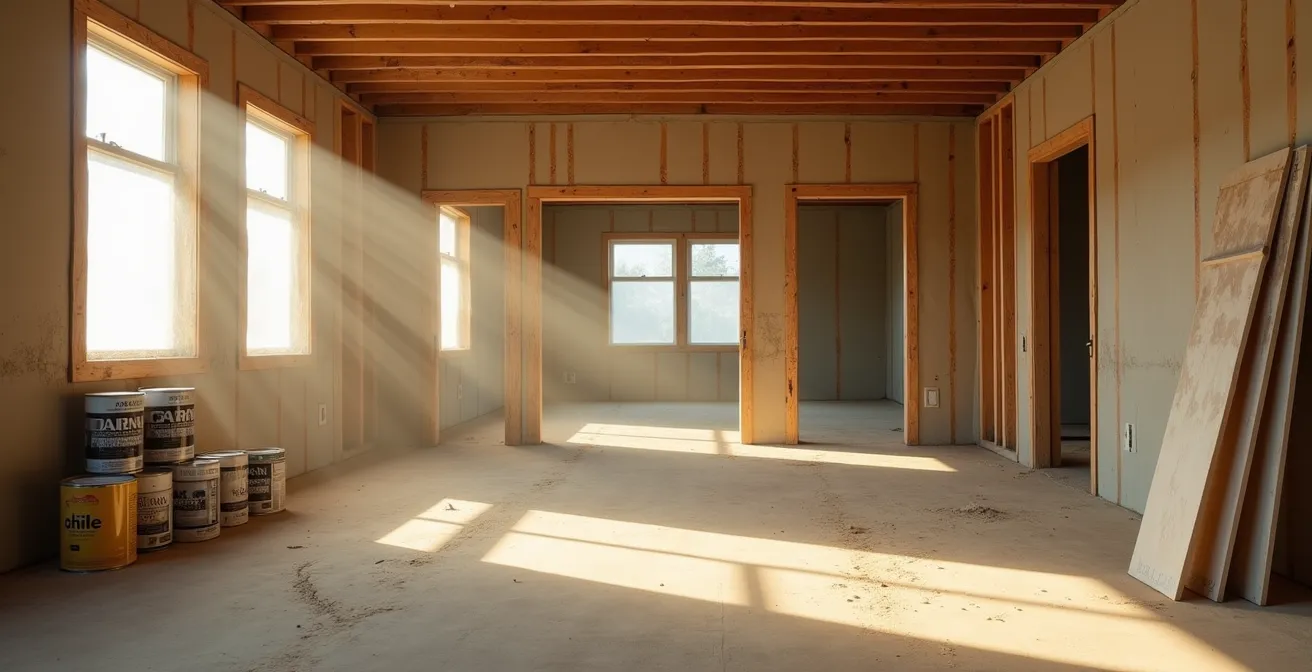
The image below illustrates a typical renovation scene, a scenario that your insurer must be made aware of before work begins, not after a loss occurs.
The key principle is disclosure. Your insurer needs to be a partner in these changes, not an adversary to be informed after the fact. Sending a written notice (email is sufficient) to your broker or agent before a renovation starts or before a new occupant with a home-based business moves in is not just good practice; it is a requirement to keep your policy in force. Hiding a material change is considered policy fraud and will almost certainly lead to claim denial.
The Thermostat Setting That Guarantees Adherence to Freeze Clauses
For those absent during colder months, the “freeze clause” or “frozen plumbing exclusion” is one of the most critical and unforgiving parts of a home insurance policy. This clause typically states that any damage resulting from frozen pipes (a leading cause of catastrophic water damage) is not covered if you failed to take reasonable precautions. “Reasonable precautions” are not left to interpretation; they are often explicitly defined, and chief among them is maintaining an adequate temperature inside the home.
Simply turning the heat down is not enough; you must set it to a specific minimum temperature. While this can vary slightly by policy, plumbers and insurers agree the optimal temperature range to prevent frozen pipes is 55-60°F (13-15°C). Setting the thermostat any lower, especially in a poorly insulated home or during a severe cold snap, is a gamble you cannot afford to take. A claim denied on the basis of this clause means you are personally liable for all repairs, which can easily run into tens ofthousands of dollars.
Proving compliance is again paramount. A traditional thermostat offers no record. This is why investing in a smart thermostat with remote monitoring and data logging is no longer a luxury but a critical risk management tool. These devices provide an indisputable digital record of the temperature maintained in your home throughout your absence. In a claims dispute, this data log can be the single piece of evidence that proves you upheld your end of the contract. Some insurers may even offer discounts for homes equipped with such technology.
Beyond the thermostat, your policy may require you to either shut off the main water supply and drain the pipes or ensure your heating system is under a maintenance contract. You must read your policy to know which is required. Ignoring this clause is one of the easiest ways to face financial disaster.
The Mistake of Letting a Friend Stay That Changes Your Occupancy Status
A common and well-intentioned mistake is to ask a friend or relative to live in the house during a long absence. The logic seems sound: the house is occupied, safe, and the 30-day vacancy rule is avoided. However, this action can inadvertently trigger a different, equally problematic issue by changing the property’s legal occupancy status. Your policy is for an “owner-occupied” home. Introducing another person, depending on the arrangement, can change that status to “tenant-occupied” or something else your policy does not cover, thereby voiding it.
The distinction lies in the legal relationship. If the person pays you in any form—even if it’s just covering utility bills—they are almost universally considered a tenant. A standard homeowner’s policy does not cover tenant-occupied properties; this requires a specific landlord policy. Even without payment, a long-term stay can create ambiguity. Is this person a guest, a house-sitter, or a de facto resident? This ambiguity is something insurers avoid, and in the event of a claim, they will scrutinize the arrangement to their advantage.
The following table outlines the critical distinctions. Understanding these differences is essential before handing over your keys.
| Aspect | House Sitter | Tenant |
|---|---|---|
| Payment | No payment accepted | Any form of payment (even utilities) |
| Primary Residence | Maintains residence elsewhere | Property becomes primary residence |
| Duration | Temporary arrangement | Ongoing occupancy |
| Insurance Impact | May maintain owner-occupied status | Voids owner-occupied policy |
| Legal Status | Custodian for owner’s benefit | Tenant with legal rights |
Case Study: The Inherited Home Fire Claim Denial
This risk is not theoretical. Consider a well-documented case where a couple inherited a home they planned to sell. While the property was empty and listed for sale, a small kitchen fire occurred. The insurance company denied their claim entirely. Why? The couple had a standard home insurance policy that contractually assumed someone was living in the home. Because it had been vacant for over 30 days, the policy’s occupancy condition was breached, and coverage was voided. This illustrates how an insurer will strictly enforce occupancy status, even for a relatively small claim.
If you choose to have someone stay, you must have a formal, written agreement that clearly defines their role as a temporary, non-resident house-sitter, with no rent or exchange of services for lodging. You must then present this plan to your insurer for written approval to ensure your coverage remains valid.
The 30-Day Rule That Voids Coverage for Empty Homes
Of all the clauses in a standard home insurance policy, the vacancy clause—often referred to as the “30-day rule”—is arguably the most critical for travelers to understand. This clause dictates the maximum number of consecutive days a home can be empty before the insurer considers it “vacant” or “unoccupied,” triggering a significant reduction or complete elimination of certain coverages. This is not a grace period; it is a hard deadline.
While the exact duration varies, most insurance companies limit coverage for homes that aren’t lived in after 30 to 60 days. Once you cross this threshold without notifying your insurer and obtaining a special “vacancy permit” or “unoccupancy endorsement,” you are in breach of your contract. The consequences are immediate. Typically, the first coverages to be suspended are for vandalism, malicious mischief, glass breakage, and water damage. In other words, the very perils most likely to affect an empty house are the ones that are no longer covered.
It’s also crucial to understand the distinction insurers make:
- Unoccupied: The property contains furniture and personal belongings, indicating an intent to return, but no one is physically living there. This is the typical status for a snowbird’s home.
- Vacant: The property is empty of both people and most personal belongings, suggesting no immediate intent to return (e.g., a house for sale).
Policies treat these differently, but both statuses fall under clauses that limit coverage after a set period. A brief overnight stay by you or a friend does not “reset the clock.” Insurers look for a genuine “intent to reside,” not a token visit. Your absence is cumulative until you genuinely re-occupy the home as your primary residence.
The Visitation Log: How Often Must You Check on Your Cottage?
For seasonal properties like cottages and cabins, which are often left unoccupied for months at a time, the principles of policy compliance are even more stringent. These properties are inherently higher risk due to their remote locations and extended periods of vacancy, making them prime targets. With over 130,000+ reports of breaking and entering in Canada in 2023 alone, many of which target unoccupied properties, insurers enforce their visitation and maintenance clauses with zero tolerance.
The question of “how often” to check depends entirely on your specific policy, but for a cottage in the off-season, weekly checks are often the minimum standard required, a significant increase from the 48-72 hour rule for a primary residence on a short vacation. The purpose of these checks is not just to look for break-ins but to ensure the property is being maintained against perils like weather damage, animal infestation, and structural issues.
This is where the visitation log becomes your most important legal document. A simple notebook or a shared digital document will suffice, but it must be meticulously maintained. Each entry must include:
- Date and Time of Visit: Creates an indisputable timeline.
- Name of Inspector: Identifies who performed the check.
- Detailed Observations: Notes on the state of the property, including heating systems, signs of leaks, window/door security, and any issues found.
- Actions Taken: What was done to rectify any issues (e.g., “Shoveled heavy snow load from deck,” “Removed fallen branch from roof”).
- Photographic Evidence: Dated photos of key areas (thermostat, locked doors, exterior) provide visual proof that corroborates the log.
Without this documented proof of diligence, an insurer can argue that you abandoned the property and neglected your duty to mitigate risk, providing them with a clear path to deny your claim. For a cottage, the log is not just a good idea; it is the evidence that your insurance contract is still valid.
Key Takeaways
- Your home insurance is a contract for an “occupied” dwelling; long absences are a material change that must be formally managed.
- Failure to adhere to specific clauses (visitation frequency, temperature, reporting changes) can automatically void coverage, often after 30 days.
- The burden of proof is on you. Documented compliance through logs, photos, and written communication with your insurer is non-negotiable.
Grace Period vs Cancellation: When Does Coverage Actually Stop?
Many policyholders operate under the dangerous misconception that there is a “grace period” after a policy breach, a window of time to fix a mistake. In the context of vacancy and unoccupancy clauses, this is fundamentally untrue. These clauses are not warnings; they are automatic triggers. The moment you exceed the 30- or 60-day limit without an endorsement, your coverage for specific perils doesn’t enter a grace period—it simply ceases to exist for those events.
If a pipe bursts on day 31 of an un-notified absence, you are likely not covered. The financial consequences are severe, as repair costs for burst pipe water damage can range from $10,000 to $70,000, or even more. The policy cancellation is not for the entire policy at first, but a surgical removal of the most relevant protections for an empty home. Full cancellation of the policy for non-payment is a different process with legally mandated warning periods. Cancellation for a breach of contract, like failing to report a material change in risk, can be far more abrupt.
The insurance market is also hardening, making it more difficult for policyholders. Insurers are becoming less forgiving as they face their own rising costs. As one expert notes, the industry is actively looking to reduce its exposure to high-risk properties.
Chances are good that until reinsurance prices come back down to earth and materials and labor cost increases triggered by COVID-19 supply chain interruption stabilize, insurers will continue to non-renew existing customers and slow underwriting and sales in the states most vulnerable to disasters associated with climate change.
– Amy Bach, Esq., United Policyholders Executive Director
This climate means insurers have little incentive to be lenient. They are scrutinizing claims more carefully and are fully within their rights to enforce the letter of the contract you signed. The coverage stops the moment your actions or inactions breach the terms of that contract.
How to Find and Fix the Coverage Gaps in Your Current Policy?
The only way to guarantee policy adherence is to move from a passive homeowner to a proactive risk manager. You cannot rely on assumptions; you must audit your policy to identify the specific clauses that apply to you and take concrete steps to comply. The reality is that many homeowners are inadequately covered without even knowing it; some reports suggest approximately two-thirds of homes in America are underinsured, and this doesn’t even account for coverage voided by policy breaches.
Your mission, before you depart, is to find and close these gaps. This requires a systematic review of your policy document, focusing specifically on any language related to “vacancy,” “unoccupancy,” “material change,” and “duties after a loss.” If the language is unclear, you must request clarification from your broker or insurer in writing. Do not accept verbal assurances; what matters is the text in the contract and any written endorsements that modify it.
An endorsement or “vacancy permit” is a formal amendment to your policy that acknowledges your extended absence and explicitly states what is and is not covered during that time. It may come with an additional premium, but this cost is the price of guaranteed coverage. This written confirmation is your single most powerful tool in the event of a claim. It replaces ambiguity with contractual certainty.
Your Pre-Departure Policy Audit Checklist
- Locate and highlight all vacancy, unoccupancy, and material change clauses in your policy document.
- Contact your insurer or broker in writing (email is best) at least 30 days before your planned extended absence, stating your departure and return dates.
- Formally request the appropriate unoccupancy permit or vacancy endorsement required by your policy for the duration of your trip.
- Review and document all coverage limitations and special requirements that apply even with the new endorsement (e.g., continued visitation schedule).
- Obtain written confirmation of all coverage modifications and any additional premium, and save it in a secure digital folder accessible while you travel.
This audit is not optional. It is the core activity that separates a prepared, compliant policyholder from one who is unknowingly gambling with their largest financial asset. The time to negotiate and clarify is before you leave, not after a disaster has struck.
Frequently Asked Questions on Vacancy and Home Insurance
What’s the difference between vacant and unoccupied?
The terms are often used interchangeably but have distinct meanings for insurers. Unoccupied means the home is not currently being lived in, but it still contains personal belongings like furniture, indicating an intent for the resident to return. This is the typical status for a vacation or extended trip. Vacant means the property is empty of both people and significant personal property, suggesting no one is actively using it or planning an imminent return, such as a house on the market after the owner has moved out.
Does a single overnight stay reset the 30-day counter?
No, this is a common and dangerous myth. Insurers do not consider a brief, token visit as a reset of the vacancy or unoccupancy period. They look for proof of a genuine “intent to reside.” To reset the clock, you would typically need to re-occupy the house as your primary residence for a continuous period. A one-night stay by you or a friend will almost certainly not satisfy this requirement in a claims dispute.
What coverage is lost first after 30 days of unoccupancy?
Once you pass the policy’s unoccupancy threshold (typically 30-60 days) without a proper endorsement, the insurer will automatically exclude coverage for specific perils. The most common coverages to be suspended first are those most associated with an empty home: vandalism, malicious mischief, glass breakage, and certain types of water damage. Fire and liability coverage may remain, but you must check your specific policy as this can vary.