
Your homeowners policy seems to cover your college student, but critical (and costly) gaps are hiding in the fine print.
- The standard 10% property limit is often insufficient for modern electronics and valuable gear.
- Liability for accidents in the dorm or damages caused by your student can be completely excluded.
Recommendation: Instead of buying a new, separate policy, proactively add a “Scheduled Personal Property” endorsement to your existing plan. It’s the most cost-effective way to get full coverage.
Watching your child head off to college is a mix of pride and anxiety. You’ve helped them pack their clothes, books, and most importantly, the expensive technology that’s essential for modern education: a laptop, a tablet, noise-canceling headphones, and maybe even specialized equipment for their major. A common assumption among parents is that their existing homeowners insurance policy automatically extends to protect these items in a dorm room. While this is partially true, relying on this basic coverage without understanding its limitations is a significant financial risk.
The standard advice often jumps to buying a separate renters or student-specific insurance policy. But what if the most efficient and cost-effective solution is already within your grasp? The key isn’t to buy more insurance, but to be smarter about the insurance you already have. This involves moving from a passive assumption of coverage to a proactive strategy of identifying and closing the hidden gaps that most standard policies contain, especially concerning electronics, liability, and specific types of theft.
This guide will walk you through the critical questions to ask about your current policy. We’ll dissect the fine print and expose the common traps that leave students underinsured. By the end, you will have a clear, practical roadmap to strategically enhance your existing homeowners plan, ensuring your child’s belongings are truly protected without the need for an entirely new and often redundant policy.
To navigate this process effectively, it’s essential to understand how different factors—from your child’s living situation to the specific items they own—impact your coverage. The following sections break down these crucial details, providing the insights you need to speak confidently with your insurance advisor.
Summary: A Parent’s Guide to Smart Student Coverage
- On-Campus or Off-Campus: How Location Changes Coverage Limits?
- Why the “10% Off-Premises Limit” Might Not Be Enough for a Student?
- The Keg Party Risk: Is Your Child Covered if Someone Gets Hurt in Their Dorm?
- Theft from a Library or Cafe: Is It Covered Like Theft from the Room?
- What Happens to Coverage When the Student Returns Home for Summer?
- The Co-Signing Error That Extends Liability Beyond Your Own Home
- Why Your Policy Won’t Cover Theft if There Was No Forced Entry?
- How to Insure Personal Electronics Against Theft, Loss, and Liquid Damage?
On-Campus or Off-Campus: How Location Changes Coverage Limits?
The first question to determine if your homeowners policy offers any protection at all is where your student lives. Insurers draw a hard line between students living in university-owned housing (like dorms) and those living in off-campus apartments. Generally, for coverage to extend from a parent’s policy, the student must be living on campus. Signing a lease for an off-campus apartment typically severs this connection, and the student will almost certainly need their own renters insurance policy.
However, even for on-campus students, coverage isn’t automatic. Most insurers have a specific set of criteria the student must meet to be considered an “insured resident temporarily residing elsewhere.” These typically include:
- Enrollment Status: The student must be enrolled full-time, as defined by the university.
- Age Limit: Coverage usually ceases once the student reaches a certain age, often under 24 or 26.
- Prior Residency: The student must have been a resident of the parent’s home before leaving for school.
If your student meets these conditions, their personal belongings in the dorm are typically covered under your policy’s “off-premises” clause. This is where the most significant limitation comes into play. Insurers don’t extend your full property coverage to the dorm; instead, most homeowners policies limit coverage to 10% of your total personal property limit. Understanding this percentage is the first step in uncovering a major potential coverage gap.
Why the “10% Off-Premises Limit” Might Not Be Enough for a Student?
The “10% rule” sounds reasonable until you do the math. If your homeowners policy includes $100,000 in personal property coverage, your student’s belongings are only covered up to $10,000. While this might seem adequate, the value of a typical student’s possessions can quickly exceed this limit, especially when expensive electronics, textbooks, and specialized equipment are involved.
Consider a film student with a $6,000 camera and a $2,000 laptop. These two items alone account for $8,000, or 80% of their total coverage, leaving little room for everything else—from clothing and furniture to a bicycle. This creates a dangerous coverage gap. To make matters worse, many standard policies impose sub-limits on specific categories. For example, there might be a $1,500 maximum payout for all electronics, regardless of the overall 10% limit. In this scenario, even with a $10,000 total limit, the student would only get $1,500 back for their stolen $2,000 laptop.

This is where proactively managing your policy becomes crucial. The most effective solution is not a new policy, but a low-cost addition to your existing one: a Scheduled Personal Property endorsement (or “rider”). This allows you to list specific high-value items (like a laptop, camera, or musical instrument) and insure them for their full replacement value, often with a $0 deductible. This carves them out of the restrictive 10% limit and sub-limits. A standalone student policy is another option, but scheduling items on your own policy is often more cost-effective. The following analysis from insurance provider NSSI shows how these options stack up.
| Coverage Type | Coverage Limit | Deductible | Accidental Damage | Average Cost |
|---|---|---|---|---|
| Parents’ Homeowners (10% limit) | $10,000 typical | $1,000-$2,500 | Not covered | No additional cost |
| Scheduled Personal Property | Full replacement value | $0-$100 | Covered | $30-60/year per item |
| Standalone Student Insurance | $5,000-$30,000 | $100-$250 | Often covered | $105-$180/year |
The Keg Party Risk: Is Your Child Covered if Someone Gets Hurt in Their Dorm?
While parents are often focused on protecting their child’s expensive belongings from theft, a far greater financial risk often goes unaddressed: personal liability. If a guest is injured in your student’s dorm room—whether they slip on a wet floor or are hurt during a party—your family could be held liable. Your homeowners policy’s liability coverage does extend to your student in the dorm, but this protection has critical and easily triggered exclusions.
The most significant liability blind spot involves alcohol. Insurance policies are designed to cover accidents and negligence, not illegal acts. As a result, if your student serves alcohol to minors and someone gets hurt, the insurer has strong grounds to deny the claim entirely. As State Farm Insurance warns in their advice for college students:
Personal liability coverage on your policy may help if a guest is injured, but the liability coverage from parents’ policy could be entirely voided due to illegal acts if the student serves alcohol to minors.
– State Farm Insurance, Insurance Tips for College Students
This risk is magnified by Social Host Liability laws, which exist in many states. These laws can hold the party host (your student and potentially you) responsible for the actions of an intoxicated guest even after they leave the premises. It’s also important to distinguish between Personal Liability, which covers major lawsuits for negligence, and Medical Payments to Others, a smaller, no-fault coverage (typically under $5,000) designed to handle minor injuries without a lawsuit. Discussing an increase in both of these coverages, or adding an umbrella policy, with your agent is a vital, proactive step.
Theft from a Library or Cafe: Is It Covered Like Theft from the Room?
Students don’t just use their laptops and tablets in their dorm rooms; they take them everywhere—the library, a local coffee shop, a friend’s apartment. The “off-premises” coverage from a homeowners policy does apply to these locations, meaning a stolen laptop is theoretically covered whether it’s taken from the dorm or a study hall. However, the circumstances of the theft are critical, and a claim for an item stolen in a public place often faces more scrutiny from an insurer.
The key factor is proving that a theft actually occurred and that the student took “reasonable care” to protect their property. If a student leaves a laptop unattended on a library table to get a coffee and returns to find it gone, an insurer might argue this constitutes negligence and could be hesitant to pay the claim. This is a gray area, but having a documented process to follow immediately after a theft can significantly strengthen your case.
Having a clear action plan is essential for navigating the claims process successfully. Filing a police report is the most critical step, as it officially documents the incident as a theft rather than a simple loss. Without a police report, a claim is almost certain to be denied.
Your Action Plan for Theft in a Public Space
- File a police report immediately; this is non-negotiable for any insurance claim.
- Notify campus or venue security within 24 hours to create a secondary record of the incident.
- Gather all proof of ownership: digital or physical receipts, photos of the item, and especially serial numbers.
- Write down a detailed account of the incident, including the location, time, and circumstances.
- Contact your insurance company within 48-72 hours, providing the police report number and all other documentation.
What Happens to Coverage When the Student Returns Home for Summer?
The rules of insurance coverage are dynamic and change with your student’s location. When your child returns home for the summer, bringing their belongings with them, the restrictive 10% off-premises limit vanishes. All their possessions are once again fully covered under the main personal property limit of your homeowners policy, just like any other family member’s belongings.
However, a significant coverage gap can emerge for students with 12-month off-campus leases or those who leave items in a dorm or storage unit over the summer. Most insurance policies contain a clause regarding “unoccupied residences.” If a property is left vacant for an extended period (often 30-60 days), coverage for certain perils, like theft or vandalism, may be reduced or eliminated entirely. A student’s empty apartment is vulnerable, and a standard policy might not cover a loss if the student hasn’t been there for over a month.

One real-world case highlights this risk: a student’s apartment was burglarized over summer break, and $3,000 worth of electronics were stolen. The claim was denied because the policy had a 45-day visitation requirement that wasn’t met. If your student is leaving items in an apartment for the summer, you must speak with your insurance agent. They may need to add a special “unoccupied residence” endorsement to maintain full coverage. This is another example of a proactive conversation that can prevent a costly claim denial.
The Co-Signing Error That Extends Liability Beyond Your Own Home
For students moving off-campus, a landlord will almost always require a parent to co-sign the lease. This is a common practice that parents often agree to without fully understanding the financial and legal ramifications. When you co-sign a lease, you are not just guaranteeing your child’s portion of the rent; you are becoming financially responsible for the *entire* lease agreement. This includes unpaid rent from all roommates and, critically, any damages to the property.
A widespread and dangerous misconception is that the liability portion of your homeowners insurance will cover you if your child or their roommates cause significant damage to the apartment. This is incorrect. As the firm American Insurance Specialists clarifies, this is a contractual risk, not a negligence risk:
Co-signing makes the parent financially liable for unpaid rent and damages, which homeowners insurance will NOT cover. The policy’s liability coverage is for negligence, not contractual obligations.
– American Insurance Specialists, College Students & Your Homeowners: Avoiding Coverage Gaps
If a roommate causes a kitchen fire or your child accidentally floods the bathroom, the landlord can—and will—come after you, the co-signer, for the full cost of repairs. Since your homeowners policy won’t pay, you are personally exposed. The only effective way to mitigate this risk is to insist that every tenant on the lease obtains their own renters insurance policy with a significant amount of liability coverage (e.g., $100,000 minimum). You should require proof of these policies before signing anything. This creates a firewall, ensuring the tenants’ policies are the first line of defense, protecting you from their contractual obligations.
Why Your Policy Won’t Cover Theft if There Was No Forced Entry?
One of the most frustrating and common reasons for a denied theft claim is the “mysterious disappearance” exclusion. Dorm life is communal and often chaotic; doors are frequently left unlocked, and friends come and go. In this environment, it’s easy for an item like a laptop or phone to vanish without any sign of a break-in. When this happens, you may have a serious problem with your insurance claim.
Insurers make a clear distinction between theft (which is covered) and mysterious disappearance (which is not). If there are no signs of forced entry—a broken lock, a smashed window—an insurer can classify the loss as a “mysterious disappearance” and deny the claim. They essentially argue that the item could have been lost or misplaced rather than stolen. This is a major coverage gap, especially in a dorm setting where students are prime targets. In fact, due to their active social lives and digital footprints, students are four times more likely to be victims of fraud by someone they know than the general population.
So, how do you fight this? The key is to transform the incident from a “disappearance” into a “theft” in the eyes of the law. The single most important action is to file a police report immediately. Even if you don’t know who took the item, reporting it as stolen creates an official record that you must submit with your claim. A case study on this issue found that students who maintain a detailed inventory with serial numbers have a 73% higher claim approval rate for thefts without forced entry. This documentation, combined with a police report, provides the proof needed to successfully navigate this tricky exclusion.
Key Takeaways
- Your homeowners policy provides only limited, default coverage for a college student, often just 10% of your personal property limit.
- The biggest risks are hidden gaps: electronics sub-limits, liability for accidents, and exclusions for theft without forced entry.
- The most cost-effective solution is not a new policy, but adding a “Scheduled Personal Property” endorsement to your existing plan for high-value items.
How to Insure Personal Electronics Against Theft, Loss, and Liquid Damage?
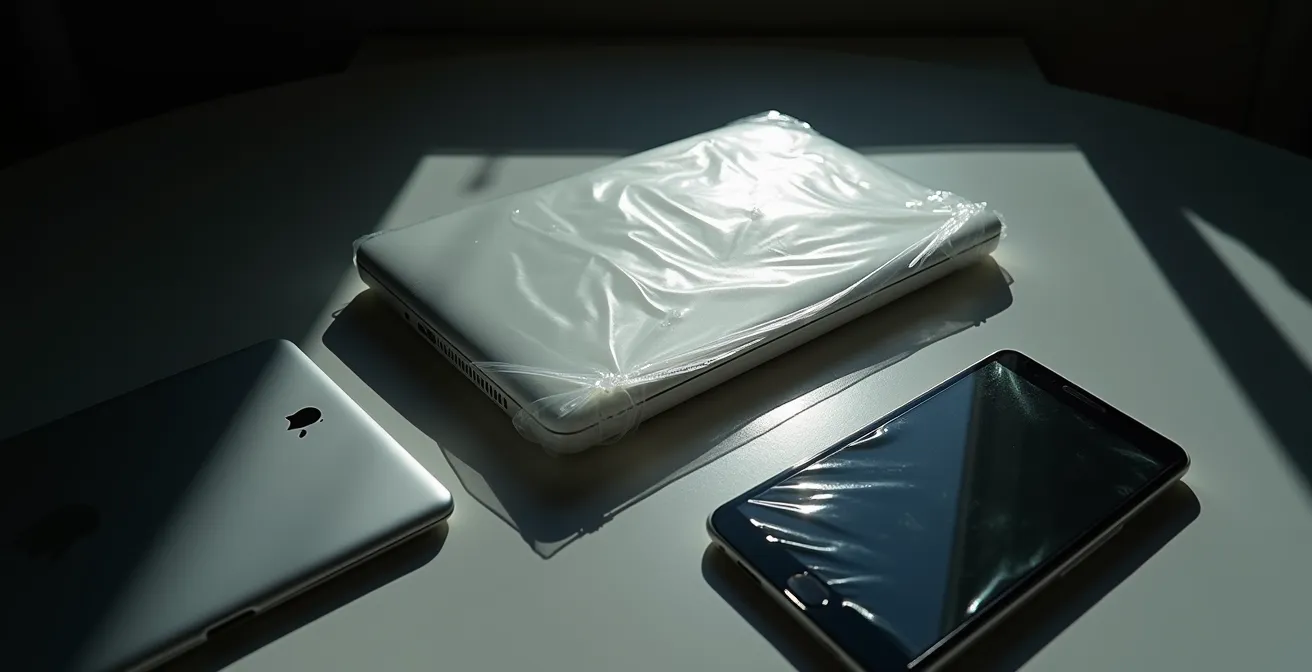
For any college student, their laptop, phone, and tablet are their lifeline. They are also the most valuable, portable, and damage-prone items they own. As discussed, a standard homeowners policy offers notoriously poor protection for these devices due to low sub-limits (e.g., $1,500 max) and, most importantly, a lack of coverage for the most common perils: accidental damage (like a cracked screen) and liquid damage. A standard policy only covers specific “named perils” like theft and fire.
To properly protect electronics, you need a solution that covers theft, loss, and accidental damage. You have several options, each with different costs and benefits. Adding a Scheduled Personal Property endorsement to your homeowners policy is often the best value. It provides “all-risk” coverage for the full replacement value, including accidental damage and loss, with a low or zero deductible. Other options include standalone student policies or gadget-specific insurance, which offer similar protections but may be more expensive if you have multiple devices.
Another critical, often overlooked risk is the “business use” exclusion. If your student uses their personal laptop or camera for any paid freelance work—like a photography major doing paid shoots or a computer science student taking on coding gigs—the insurer can deny a claim if that item is stolen or damaged, arguing it was commercial equipment. A photography student once had a claim for a stolen $3,500 camera denied because they had used it for freelance jobs. The solution is to ensure your policy endorsement explicitly covers “incidental business use” or to purchase a separate small business policy if their work becomes more serious.
The following table breaks down how different insurance types handle the specific risks associated with electronics.
| Coverage Type | Theft | Accidental Damage | Liquid Damage | Loss | Typical Deductible | Annual Cost |
|---|---|---|---|---|---|---|
| Standard Homeowners | Yes (with limits) | No | No | No | $1,000-$2,500 | Included |
| Scheduled Personal Property | Yes | Yes | Yes | Yes | $0-$100 | $30-60 per item |
| Student Property Insurance | Yes | Yes | Yes | Sometimes | $25-$100 | $100-200 total |
| Gadget Insurance | Yes | Yes | Yes | Yes | $50-$200 | $60-180 per device |
Frequently Asked Questions About College Student Insurance
What’s the difference between Personal Liability and Medical Payments coverage?
Medical Payments covers minor injuries (typically under $5,000) without requiring a lawsuit, acting as a goodwill gesture to prevent larger claims. Personal Liability protects against major lawsuits for negligence with much higher financial limits, covering legal fees and settlements.
Does liability coverage apply to damage in university buildings?
It depends. Accidental damage, such as unintentionally triggering a fire sprinkler system that causes water damage to a dorm, may be covered by your liability insurance. However, intentional damage or issues considered normal wear and tear are always excluded.
What about Social Host Liability laws?
These state-specific laws can hold students, and sometimes their parents, legally responsible for the actions of intoxicated guests, even after those guests have left the party. This dramatically extends the scope of risk beyond just an injury occurring within the dorm room itself.