Standard homeowner’s insurance is void during a rental, leaving your most valuable asset and its income stream completely exposed.
- “Business activity” exclusions in personal policies are a primary reason for claim denials.
- Platform coverages like AirCover are secondary and fail to cover loss of income or off-platform bookings.
- Specialized commercial policies are designed to protect both the physical property and its function as a revenue-generating business.
Recommendation: Immediately audit your current policy for business exclusions and secure a commercial short-term rental insurance quote to ensure comprehensive asset protection.
As a vacation rental host, you’ve likely experienced the moment of realization: the standard homeowner’s policy you’ve relied on for years contains a “business activity” exclusion clause. This single clause means that the moment a paying guest steps across your threshold, your insurance coverage may become null and void. This isn’t a minor detail; it’s a critical vulnerability that exposes your entire investment to catastrophic risk, from a simple liability claim to a total loss of the property from a fire.
Many hosts initially turn to the insurance offered by platforms like Airbnb (AirCover) or Vrbo, believing it’s a sufficient safety net. While these programs offer a layer of liability protection, they are not a substitute for a primary insurance policy. They are designed to protect the platform first and often contain significant gaps regarding property damage, loss of income, and incidents related to high-risk amenities. The common approach of relying on a patchwork of personal policies and platform protection is fundamentally flawed because it fails to address the core reality of your operation.
The key to properly insuring your property is to stop thinking like a homeowner and start thinking like a business owner. Your vacation rental is not just a house; it is a revenue-generating asset, and its protection requires a strategic, commercial-grade solution. This guide is built to shift your mindset from simply insuring a structure to implementing a robust strategy for asset protection and income stream security. It will dissect the specific risks your short-term rental business faces and outline the precise coverage needed to mitigate them effectively.
This article provides a business-focused breakdown of the essential insurance components for your vacation rental. We will explore the critical policy exclusions you must understand, compare platform insurance to commercial policies, and detail how to cover everything from guest-caused damage to the income you stand to lose after a disaster. The following sections offer a clear roadmap to securing your investment.
Summary: Insuring Your Vacation Rental Business
- The “Business Activity” Exclusion That Voids Your Policy During a Rental
- AirCover or Vrbo Liability: Can You Rely on the Platform’s Insurance?
- Intentional Damage by Guests: The Gap That Most Policies Miss
- Loss of Rents: How to Insure Future Bookings After a Fire?
- Pools, Bikes, and Kayaks: How to Insure Extra Amenities for Guests?
- The Rental Mistake That Leaves Your Granny Flat Uninsured
- How to Insure a Home with “Dangerous” Breeds or Exotic Animals?
- How to secure Your Rental Income Stream Against Physical Disasters?
The “Business Activity” Exclusion That Voids Your Policy During a Rental
The single most dangerous assumption for a new short-term rental host is that their homeowner’s insurance provides adequate coverage. In reality, virtually every standard HO-3 or HO-5 policy contains a “business pursuits” or “business activity” exclusion. This clause is specifically written to absolve the insurer of responsibility for claims arising from commercial operations conducted on the property. From the insurer’s perspective, renting your home to a series of transient guests is a business, fundamentally altering the risk profile from that of a private residence.
This exclusion is not a minor technicality; it’s the basis upon which claims are denied. If a guest slips and falls, or if a kitchen fire starts during a rental period, your insurer has grounds to refuse the claim entirely, citing the commercial nature of the activity. Most homeowners policies exclude business activities and will deny claims for any damage or liability that occurs while a paying guest is present. This leaves you personally liable for medical bills, legal fees, and the full cost of property repairs, potentially jeopardizing your entire financial future.
Identifying this risk in your own policy is paramount. You must become an expert at spotting the red flags that indicate your coverage is insufficient. Look for specific phrases like “rental to others,” “property held for rent,” or “paying guests.” The presence of any such language confirms that your personal policy is not designed for your business operations. Understanding this exclusion is the first critical step toward securing a policy that offers true asset protection for your rental business, not just your home.
AirCover or Vrbo Liability: Can You Rely on the Platform’s Insurance?
When confronted with the gaps in their homeowner’s policy, many hosts look to the insurance products offered by booking platforms, such as Airbnb’s AirCover for Hosts or Vrbo’s Liability Insurance. While marketed as comprehensive protection, it’s crucial to understand their role and limitations. These are not primary insurance policies; they are typically secondary or excess coverage. This means they are designed to kick in only after your primary insurance (if any applies) has been exhausted.
A significant limitation is their scope. This coverage only applies to bookings made through their specific platform. If you accept a direct booking or list your property on multiple sites, you have zero protection from platform insurance for those stays. This creates a dangerous patchwork of coverage that leaves your business exposed. Furthermore, platform policies are primarily focused on liability and limited property damage; they generally offer little to no coverage for one of the most significant financial risks: loss of rental income.
The claims process itself highlights the difference between relying on a platform and having a dedicated commercial policy. This following comparison table illustrates the fundamental differences in how claims and coverage are structured.
A direct comparison reveals why a dedicated policy provides superior business continuity, as shown in this analysis of different insurance structures.
| Coverage Aspect | Platform Insurance (AirCover/Vrbo) | Dedicated Commercial Policy |
|---|---|---|
| Coverage Type | Secondary/Excess | Primary |
| Off-platform Bookings | Not Covered | Fully Covered |
| Loss of Income | Limited/None | Comprehensive |
| Claims Process | Through platform support | Direct with insurer |
| Common Area Damage | Often Excluded | Typically Included |
Case Study: Kitchen Fire Claim Process Comparison
A real-world scenario demonstrates the difference: With a commercial policy, hosts communicate directly with an adjuster and receive claims payment within 30 days. With platform coverage, hosts must navigate customer service, require guest cooperation for documentation, and may face delays of 60-90 days or claim denial if the guest doesn’t cooperate.
Ultimately, while platform insurance provides a valuable layer of liability protection, relying on it as your sole coverage is a significant business risk. It is a supplement, not a substitute, for a robust commercial policy designed for the unique needs of a short-term rental business.
Intentional Damage by Guests: The Gap That Most Policies Miss
One of the most frustrating and financially damaging events a host can face is intentional damage or vandalism by a guest. While accidental damage is a standard covered peril in most policies, many fall short when the damage is malicious. Standard homeowner’s policies and even some basic landlord policies may contain exclusions for “malicious mischief” or vandalism caused by a tenant or guest, considering them a unique risk class.
This coverage gap can leave hosts to foot the bill for smashed furniture, broken windows, or graffiti. Even when coverage is available, the claims process for intentional damage is rigorous and requires meticulous documentation. Insurers will demand irrefutable proof that the damage was caused by the guest during their stay and that it was not pre-existing. Without a clear and organized documentation strategy, your claim is likely to be delayed or denied.
Your ability to successfully file a claim for intentional damage rests on your ability to prove what happened. This involves more than just taking a few photos after the fact. A professional approach to property management includes documenting the condition of your asset before every single stay. The following illustration highlights the professional standard for documenting property condition, a critical step in protecting your investment against guest-related damages.
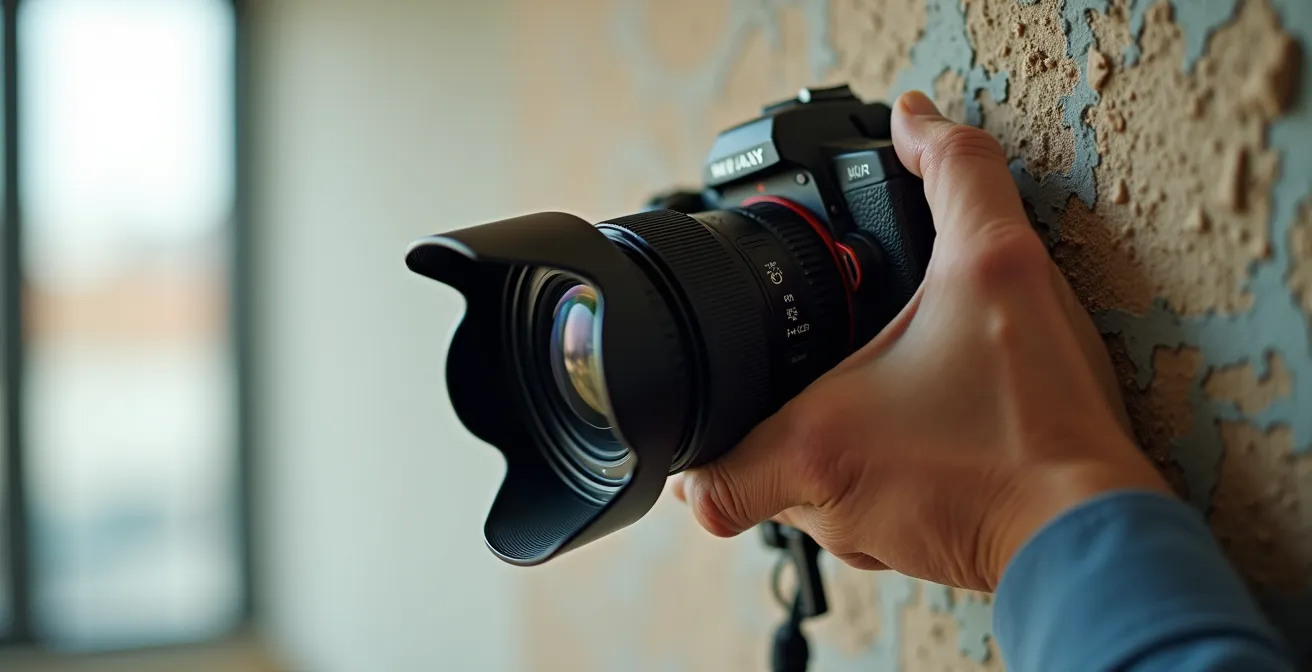
As the image suggests, professional-grade documentation is key. To ensure your claim is successful, you must have a system in place. This includes:
- Take time-stamped photos and videos of the entire property before every check-in.
- Save all text, email, and platform message conversations with the guest.
- File a police report immediately for any acts of vandalism or significant theft.
- Document the security deposit withholding process through the booking platform.
- Maintain a detailed inventory list of your property’s contents with estimated replacement values.
A dedicated short-term rental policy is specifically designed to cover this risk, but your adherence to strict documentation protocols is what will ultimately determine the outcome of your claim.
Loss of Rents: How to Insure Future Bookings After a Fire?
When a disaster like a fire or major water leak renders your vacation rental uninhabitable, the cost of repairs is only part of the financial equation. The more significant, long-term damage is often the loss of rental income during the months it takes to rebuild. Every cancelled booking represents lost revenue, directly impacting your business’s cash flow and profitability. Standard insurance policies, including many basic landlord policies, do not automatically cover this lost business income.
This is where “Loss of Rents” or “Business Income” coverage becomes one of the most critical components of a commercial short-term rental policy. This specific coverage is designed to reimburse you for the rental income you lose while your property is undergoing repairs due to a covered peril. It effectively acts as a financial bridge, allowing you to meet your mortgage obligations, pay property taxes, and cover other fixed expenses even when your property is not generating revenue. The coverage is typically based on your property’s historical rental performance or fair market rental value.
Without this protection, a single major incident could not only cost you thousands in repairs but also cripple your income stream for an extended period, potentially forcing you out of business. Insuring your income is just as important as insuring the physical structure. It is the cornerstone of a resilient business continuity plan. For hosts seeking to protect their investment truly, ensuring their policy includes comprehensive loss of rents coverage is non-negotiable.
Action Plan: Preparing a Loss of Rents Claim
- Gather Profit & Loss (P&L) statements for the past 2-3 years to establish income history.
- Screenshot all cancelled reservations from booking platforms as proof of lost business.
- Obtain market-rate and occupancy reports from services like AirDNA to project future losses.
- Secure an official timeline for repairs from your contractor to define the indemnity period.
- Document any Civil Authority orders (e.g., mandatory evacuations) that prevent access to the property.
Successfully navigating a loss of rents claim requires diligent preparation. The checklist above, based on guidance for property owners filing complex claims, outlines the essential documentation you’ll need to provide your insurer to validate your lost income.
Pools, Bikes, and Kayaks: How to Insure Extra Amenities for Guests?
Amenities like swimming pools, hot tubs, bicycles, kayaks, and trampolines are powerful tools for attracting guests and commanding higher rental rates. However, from an insurance perspective, they are significant liability multipliers. Each amenity you offer introduces a new potential for guest injury, and your standard liability coverage may not be sufficient to cover the immense risk associated with these “attractive nuisances.”
A guest injured while using a kayak or a child having an accident near an unfenced pool can lead to a multi-million-dollar lawsuit. A standard personal liability limit of $300,000 or $500,000 would be exhausted almost instantly in such a scenario, leaving your personal and business assets exposed to legal judgments. This is why a one-size-fits-all approach to insurance fails for amenity-rich properties. You must proactively address the specific liabilities each amenity introduces, both through physical safety measures and enhanced insurance coverage.
As this image of a well-managed rental property suggests, providing amenities goes hand-in-hand with implementing robust safety protocols. This includes proper fencing, safety signage, regular equipment maintenance, and locked storage. These steps are crucial for risk mitigation.
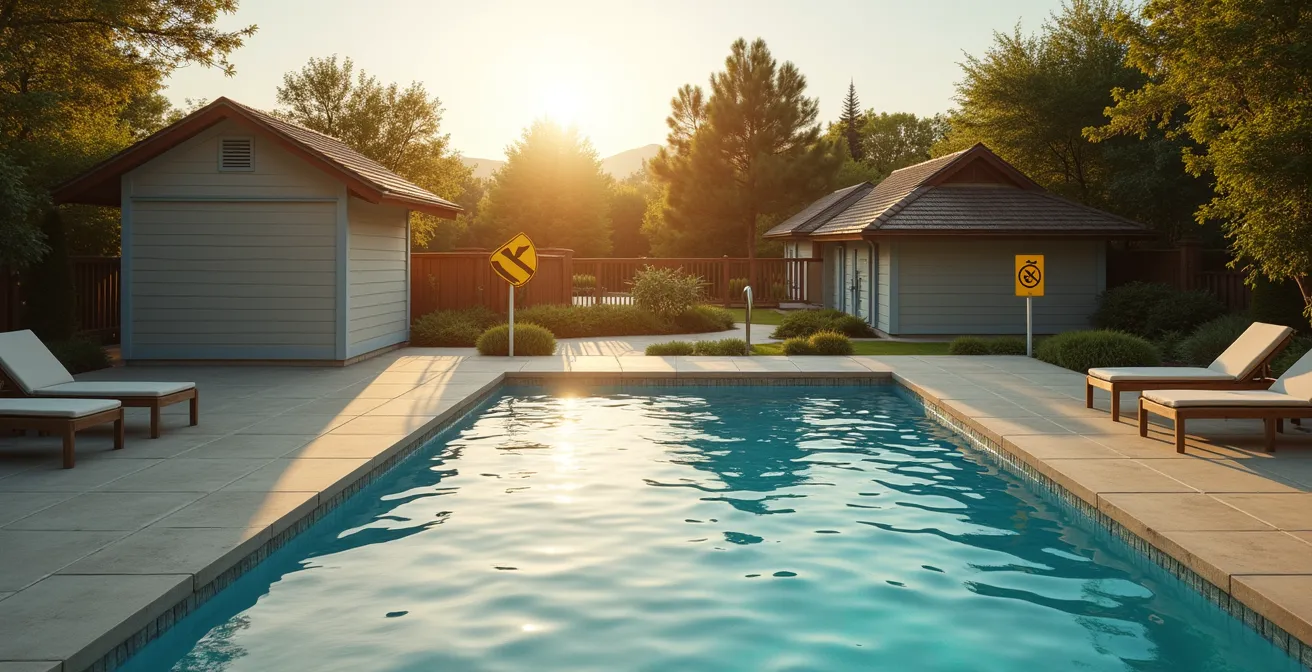
However, physical safety measures are not enough. Your insurance policy must reflect the heightened risk. This often requires two key actions: first, ensuring your primary commercial policy does not have exclusions for these specific activities, and second, securing a high-limit commercial umbrella policy. An umbrella policy provides an additional layer of liability protection (typically $1 million to $5 million) on top of your primary policy, offering the financial defense necessary to withstand a major claim.
A pool or trampoline isn’t just an amenity; it’s a legal magnet for liability, even for trespassers, and requires specific policy endorsements or a standalone umbrella policy.
– Insurance Industry Expert, Vacation Rental Insurance Guide
Treating amenities as a core part of your business strategy means investing in their protection with the same seriousness as the property itself.
The Rental Mistake That Leaves Your Granny Flat Uninsured
Accessory Dwelling Units (ADUs), such as granny flats, detached guest houses, or converted garages, are increasingly popular as short-term rentals. However, they present a unique insurance challenge that many hosts overlook. The common mistake is assuming the ADU is automatically covered under the main home’s insurance policy. While a standard homeowner’s policy does include “Other Structures” coverage, it is dangerously inadequate for a rental unit.
First, as insurance experts warn, standard ‘Other Structures’ coverage is often only 10% of the main dwelling’s insured value. If your main home is insured for $500,000, your ADU is likely only covered for $50,000. This is rarely enough to rebuild a fully finished guest house after a total loss. Second, and more importantly, this limited coverage is still subject to the “business activity” exclusion. If the ADU is being used as a short-term rental, any claim for damage or liability occurring during a stay can be denied, leaving you with zero coverage.
Properly insuring a rental ADU requires treating it as a separate business entity. You cannot rely on a simple endorsement to your personal policy. Depending on the unit’s value and your operational scale, you have several commercial-grade options to ensure full asset protection.
The following table breaks down the most common solutions for insuring an ADU used for short-term rentals. Choosing the right one depends on your specific property setup and risk tolerance.
| Solution Type | Coverage Level | Cost Impact | Best For |
|---|---|---|---|
| Other Structures Endorsement | Limited to percentage | Low additional cost | Small, attached units |
| Standalone DP-3 Policy | Full separate coverage | Moderate cost | Detached ADUs |
| Commercial Package Policy | Comprehensive | Higher cost | Multiple rental units |
For any host operating a rental in a detached structure, a standalone Dwelling Fire (DP-3) policy or a comprehensive commercial package policy is the only way to guarantee coverage for both the structure and the liability associated with its use as a business.
How to Insure a Home with “Dangerous” Breeds or Exotic Animals?
Allowing pets in a vacation rental can significantly increase bookings, but it also introduces complex liability risks, especially concerning animals often labeled as “dangerous breeds” by insurance carriers (e.g., Pit Bulls, Rottweilers, Dobermans). Many standard insurance policies contain outright animal liability exclusions or lists of prohibited breeds. If a guest’s dog, regardless of its history, were to bite another guest or a neighbor, a policy with such an exclusion would leave you completely unprotected from the ensuing lawsuit.
The challenge extends beyond guest pets to your own. If you live on the property or nearby and own a “prohibited” breed, you may find it difficult to secure any coverage at all. Insurers view these animals as a statistically higher risk for bite claims, which are among the most expensive liability claims they face. Simply hoping for the best is not a viable business strategy. You must proactively address this risk with a clear policy and the right insurance endorsements.
A forward-thinking strategy involves shifting the primary liability back to the pet owner. This not only mitigates your risk but also reinforces the guest’s responsibility.
Case Study: Guest Pet Liability Coverage Strategy
Property managers are implementing proactive strategies by requiring guests with pets to provide proof of their own renter’s or homeowner’s insurance with liability coverage extending to their animals. This approach shifts liability risk while maintaining pet-friendly status.
In addition to requiring guest insurance, securing your own protection is critical. This means finding a short-term rental policy that either has no animal liability exclusion or offers a specific “animal liability endorsement.” For hosts who own a restricted breed themselves, a standalone “canine liability policy” may be the only solution. It’s also vital to understand the legal distinctions between pets, Service Animals, and Emotional Support Animals (ESAs), as they have different protections under the law and impact your insurance requirements differently.
Key Takeaways
- Your homeowner’s policy is voided by the “business activity” of short-term renting.
- Platform insurance (AirCover, Vrbo) is a secondary supplement, not a primary policy, and won’t cover your lost income.
- A commercial short-term rental policy is essential for protecting both the physical asset and, crucially, the income stream it generates.
How to secure Your Rental Income Stream Against Physical Disasters?
For a vacation rental owner, a physical disaster like a hurricane, flood, or wildfire represents a dual threat. The first is the immediate damage to the property itself. The second, and often more financially devastating, is the long-term interruption of the business. Securing your income stream against these events requires looking beyond standard property coverage and focusing on specialized endorsements that address the full scope of disaster recovery for a business.
A critical but often overlooked coverage is “Ordinance or Law.” After a major disaster, local municipalities often update building codes. If your damaged property must be rebuilt to meet these new, stricter standards (e.g., elevating the structure in a flood zone), the additional cost can be enormous. Standard policies only pay to restore the property to its *previous* condition. Only Ordinance or Law coverage will pay for the increased cost of compliance with new regulations, a gap that can amount to hundreds of thousands of dollars.
Case Study: Hurricane Building Code Compliance Scenario
A hurricane damages 50% of a vacation rental property. While standard insurance covers repairs, new building codes require elevating the entire structure. Only ‘Ordinance or Law’ coverage addresses the massive cost of demolition and compliance with new regulations, potentially saving owners hundreds of thousands in unexpected expenses.
True income security requires a comprehensive business continuity plan. This plan should be a living document that outlines exactly how your business will operate in the face of a crisis. It goes beyond insurance to include operational logistics, communication strategies, and risk-specific preparations. The components should include:
- Maintaining a list of pre-vetted emergency contractors (plumbers, roofers, restoration companies).
- Creating crisis communication templates for current and future guests.
- Developing an online reputation management strategy to handle negative reviews during downtime.
- Establishing partnerships with other local hosts for alternative accommodations.
- Documenting regional disaster risks and obtaining specific coverage (e.g., flood, earthquake) which are excluded from standard policies.
By combining robust insurance with a proactive continuity plan, you transform your operation from a fragile house into a resilient business capable of weathering any storm.
To properly protect your investment and ensure its continued profitability, the next logical step is to engage an insurance specialist for a tailored assessment. They can help you identify the specific commercial policies and endorsements needed to transform your insurance from a mere expense into a core component of your business’s long-term asset protection strategy.
Frequently Asked Questions About Vacation Rental Insurance
Are Service Animals covered differently than pets?
Yes, Service Animals are protected under the Americans with Disabilities Act (ADA) and must be accepted regardless of breed restrictions. This requires you to have an insurance policy that does not contain animal liability exclusions, as you cannot legally refuse a guest with a legitimate Service Animal.
Can I require insurance for Emotional Support Animals (ESAs)?
ESAs have different legal protections than Service Animals and are governed by Fair Housing Act (FHA) rules, which can be more ambiguous for short-term lodging. While you may be able to request documentation, you generally cannot deny a stay based solely on their inability to provide separate insurance for the ESA. This reinforces the need for your own policy to be free of animal exclusions.
What endorsements protect against animal-related claims?
An “Animal Liability Endorsement” added to your commercial policy can provide coverage for incidents involving any animal on your property, regardless of owner. For hosts who own a breed that is difficult to insure, a standalone “Canine Liability Policy” is a specialized product that offers dedicated protection against bite claims.