In summary:
- Your role is not passive; you are the first-responder for your own claim. Your actions in the first 48 hours are decisive.
- You have a “duty to mitigate,” meaning you must take reasonable steps to prevent further damage immediately.
- Preserving evidence is non-negotiable. This includes filing police reports for theft and keeping broken parts for subrogation.
- Cooperation with your insurer is a policy requirement. Refusing access or withholding documents can lead to a “failure to cooperate” denial.
- Understanding the difference between covered “water damage” and excluded “flood damage” is critical to navigating disputes.
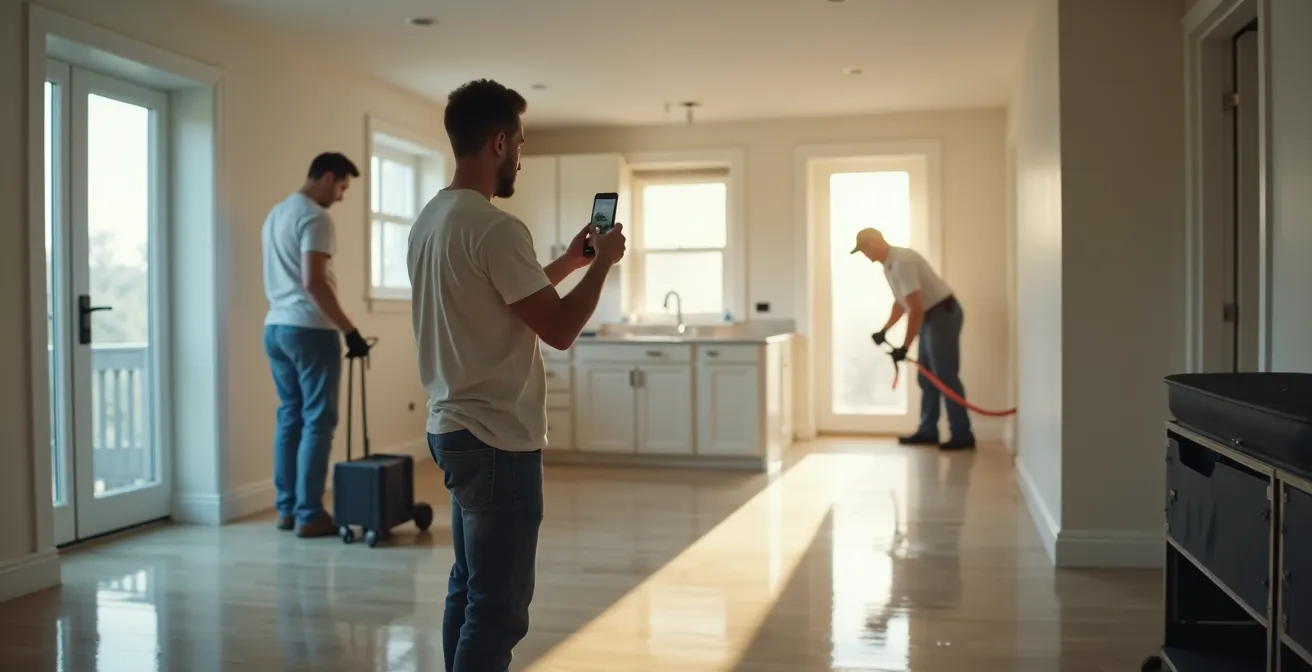
When disaster strikes your home—a burst pipe, a kitchen fire, or a break-in—your first instinct is to call your insurance agent. Many homeowners believe this single act is the beginning and end of their responsibility. They wait for an adjuster to arrive, assess the damage, and cut a check. This is a catastrophic mistake. The truth is, the moment a loss occurs, a clock starts ticking, and you are not a passive victim; you are the active first-responder for your own financial recovery.
The standard advice to “document the damage” and “make temporary repairs” is dangerously vague. It fails to convey the urgency and the specific legal duties your policy imposes on you. Every action you take, or fail to take, from the moment you discover the damage is a piece of evidence. This evidence will either build a strong, undeniable case for full compensation or create the very loopholes your insurer can use to delay, diminish, or deny your claim entirely.
This is not about being cynical; it is about understanding the process. Your insurance policy is a contract with duties for both sides. While the insurer must act in good faith, you have an immediate and critical “duty to cooperate” and “duty to mitigate.” This guide moves beyond the platitudes. It provides a directive, urgent checklist of your absolute obligations, explaining the severe consequences of inaction and empowering you to take control of your claim from the very first hour.
This article will detail the critical, time-sensitive actions you must take to protect your rights and maximize your settlement. The following sections break down your non-negotiable responsibilities, from immediate damage control to preserving the evidence that will prove your case.
Summary: What Are Your Immediate Obligations After a Loss to Save Your Claim?
- Why You Must Stop the Leak Even Before the Adjuster Arrives?
- How to Mitigate Water Damage Immediately to Preserve Your Claim Rights?
- Immediate vs As Soon as Practicable: How Long Can You Wait to File?
- The “Failure to Cooperate” Denial: Refusing Interviews or Documents
- Theft or Vandalism: Why a Police Report Is Non-Negotiable?
- Why Throwing Away the Broken Pipe Can Kill Your Subrogation Chances?
- Throw Away or Keep: What Debris Must You Save for the Adjuster?
- Why Water Damage Is the Most Contested Insurance Claim?
Why You Must Stop the Leak Even Before the Adjuster Arrives?
The adjuster is not an emergency plumber. Their job is to assess damage, not prevent it. Your policy contains a “duty to mitigate,” which legally obligates you to take reasonable steps to stop the damage from getting worse. For a water loss, this means your absolute first priority—before you even call your agent—is to stop the flow of water. Failure to do so can be interpreted as negligence, allowing the insurer to argue that a significant portion of the damage was preventable and therefore not covered. This is the first test of your role as a claim first-responder.
The damage caused by the initial pipe burst is the covered loss. The subsequent damage that occurs because water continues to pour into your home for hours while you wait for instructions is a secondary loss you may be held responsible for. With about 1 in 60 insured homes making a claim for water damage each year, insurers are experts at differentiating between the initial event and a failure to mitigate. Acting immediately not only saves your property but also demonstrates your compliance with the policy terms, strengthening your position from the very start.
This isn’t just about water. If a tree falls on your roof, your duty is to put a tarp over the hole to prevent rain from destroying the interior. If a window is broken, your duty is to board it up to secure the property. You are expected to act with the same urgency you would if you had no insurance at all. Document your actions, but do not wait for permission to protect your home from further harm. Your claim’s integrity depends on it.
How to Mitigate Water Damage Immediately to Preserve Your Claim Rights?
Mitigation is not repair. This is a critical distinction that trips up many homeowners. Mitigation means stopping further damage and stabilizing the environment. Repair means trying to fix or replace damaged items. Your insurer must be given the opportunity to inspect the damage before you begin permanent repairs. However, you are required to start mitigation immediately. For water damage, this involves a specific sequence of urgent actions aimed at preventing the most destructive secondary effect: mold.
The clock on mold growth is terrifyingly fast. According to restoration experts, mold and mildew can begin to grow on damp surfaces within just 24 to 48 hours. Standard homeowners policies often have significant limitations or exclusions for mold damage. If the insurer can prove that the mold grew because you failed to take prompt drying actions, they can deny that part of the claim. This is why calling a 24/7 professional water damage restoration company is a mitigation step, not a repair.
Your immediate mitigation plan should include these priorities:
- Water Extraction: Remove standing water using pumps or shop vacs.
- Dehumidification: Place industrial-grade dehumidifiers and air movers to dry out the structure and air.
- Removal of Wet Items: Move wet rugs, furniture, and belongings to a dry area or outside to prevent moisture from wicking into walls and flooring.
- Controlling the Source: The response varies based on the water type. Clean water from a supply line (Category 1) is less hazardous than “gray water” from a dishwasher (Category 2) or “black water” from a sewage backup (Category 3), which is a biohazard requiring professional handling.
By executing these steps, you are not just saving your property; you are building an evidentiary chain that proves you acted responsibly to preserve your claim rights.
Immediate vs As Soon as Practicable: How Long Can You Wait to File?
Your policy requires you to provide “prompt notice” of a claim or to report it “as soon as practicable.” These phrases sound flexible, but they are legal terms with serious implications. Waiting too long to report a claim can jeopardize it entirely. The insurer can argue that your delay prevented them from conducting a timely investigation, assessing the original damage, or determining the true cause of loss. While there is no universal deadline, waiting weeks or months is almost always a fatal error.
The “practicable” part of the clause provides some leeway for extraordinary circumstances, such as a medical emergency or being out of the country. It does not mean you can wait until it’s convenient. As a rule of thumb, you should report any significant property damage within 24 to 72 hours. This immediate notification creates an official start date for your claim and triggers the insurer’s own set of legal deadlines for responding.

For example, some state laws impose strict timelines on insurers once they receive notice. A case study of Texas law shows that insurers have 15 days to acknowledge the claim and begin an investigation, and they must pay within five business days after a settlement is reached. By providing prompt notice, you activate these consumer protections. A delay on your part gives the insurer a powerful excuse for their own delays or for questioning the validity of your entire claim. Do not give them that opening. Documenting your loss and reporting it promptly are two sides of the same coin.
The “Failure to Cooperate” Denial: Refusing Interviews or Documents
After you file a claim, your relationship with the insurer becomes an ongoing investigation. Your policy includes a “Cooperation Clause,” which is not a suggestion—it is a condition of coverage. A “failure to cooperate” is a common reason for claim denial. This means you must make the property available for inspection, provide requested documents, and, in some cases, submit to an interview or even an Examination Under Oath (EUO).
This does not mean you must blindly comply with every request. The insurer’s requests must be reasonable and relevant to the claim. However, outright refusal is a red flag that can be used against you. For instance, refusing to let an adjuster inspect the damaged roof or withholding receipts for a stolen television can be grounds for denial. You are obligated to prove your loss, and that requires a degree of transparency.
The key is to understand what is required versus what is overreach. Providing a recorded statement without preparation or signing a blanket medical authorization form can be risky. This is where a clear understanding of your duties is essential. The following checklist can help you navigate this complex obligation.
Action plan: Navigating cooperation requirements with your insurer
- Green Light (Must Do): Immediately grant access for site inspections by the adjuster, promptly submit completed proof of loss forms as requested, and show the damaged property before it is repaired or discarded.
- Yellow Light (Be Cautious): Think carefully before giving a recorded statement without legal counsel or personal preparation. Scrutinize any broad authorization forms that give the insurer access to unrelated personal information.
- Red Light (Seek Legal Advice): Immediately consult an attorney if the insurer demands unrelated financial documents (like full tax returns for a water claim), or requests an Examination Under Oath (EUO) without you having legal representation present.
- Document All Communications: Maintain a detailed log of every phone call, email, and letter. Note the date, time, the representative’s name, and a summary of the conversation. This creates your own evidentiary chain.
- Formalize Key Requests: If you make a request or provide important information, follow up with a certified letter. This provides irrefutable proof of your communication and cooperation.
By navigating this process carefully, you fulfill your duty to cooperate without compromising your rights, effectively neutralizing one of the insurer’s most common denial strategies.
Theft or Vandalism: Why a Police Report Is Non-Negotiable?
If your loss is the result of a criminal act like theft, burglary, or vandalism, filing a police report is not an optional step. It is an absolute requirement for your insurance claim. Many homeowners hesitate, thinking it’s a hassle or that the police won’t be able to recover their property. This thinking is flawed. The police report’s primary function in an insurance context is not recovery; it is third-party validation.
Without a police report, the only evidence that a crime occurred is your own word. Insurers can—and often will—raise doubts about whether the event happened as described or if it happened at all. A police report serves three critical functions for your claim: it establishes an independent date and time of loss, it creates an official record of the event that is difficult for an insurer to dispute, and it is often explicitly required by the policy’s terms and conditions. Attempting to file a theft claim without one is a near-certain path to denial.
You must file the report as soon as you discover the crime, typically within 24 hours. The official documentation required varies by the type of loss, but for criminal acts, the police report is paramount.
This table outlines the essential official documentation required for different types of property loss, highlighting the severe consequences of failing to file.
| Type of Loss | Required Documentation | Time Frame | Consequence of Non-Filing |
|---|---|---|---|
| Theft/Burglary | Police Report | Within 24 hours | Claim may be denied |
| Vandalism | Police Report | Within 48 hours | Coverage questioned |
| Fire | Fire Department Report | Immediate | Investigation delayed |
| Auto Damage | Police Report (if hit & run) | Within 72 hours | Reduced compensation |
Why Throwing Away the Broken Pipe Can Kill Your Subrogation Chances?
After a water leak is repaired, your first instinct is to clean up and throw away the broken parts—the burst supply line, the faulty valve, the cracked water heater tank. This is another critical error. That piece of debris is not trash; it is crucial evidence. It is the key to your insurance company’s right to subrogation. Subrogation is the legal process where your insurer, after paying your claim, can pursue the responsible third party to recover the money.
For example, if a newly installed washing machine hose fails and floods your home, your insurer pays for your damages. With the faulty hose as evidence, they can then sue the hose manufacturer to get their money back. This is their subrogation potential. However, if you throw the hose away, you have destroyed the primary evidence. This is known as “spoliation of evidence.” When you do this, you may violate a clause in your policy, and your insurer could potentially refuse to cover the claim or even seek reimbursement from you for their lost subrogation opportunity.
Your duty is to preserve this evidence. This means you must:
- Photograph the damaged item in its original location before it is moved.
- Tag and label the evidence clearly with the claim number and a warning like “DO NOT DISCARD – EVIDENCE.”
- Store the parts in a safe, dry location where they won’t be lost or damaged further.
- Document all manufacturer information, model numbers, and installation dates if available.
You should never dispose of this key evidence until the claim is fully and finally settled and you have written approval from the adjuster. That broken part could be worth thousands of dollars to your insurer, and protecting it is part of your contractual duty.
Key takeaways
- Immediate mitigation is a policy duty; failure to stop ongoing damage can lead to partial or full claim denial.
- Promptly reporting a claim (ideally within 72 hours) activates insurer deadlines and prevents them from claiming prejudice due to delay.
- You must preserve all damaged parts and debris, as they are crucial evidence for quality verification and the insurer’s subrogation rights.
Throw Away or Keep: What Debris Must You Save for the Adjuster?
After a loss, your home may be filled with damaged, wet, or contaminated debris. The dilemma is clear: you need to clean up for safety and to begin mitigation, but the adjuster needs to see the proof of what was damaged. Throwing everything away is spoliation of evidence, but keeping a house full of moldy drywall is a health hazard. The solution lies in a strategy of documentation, selective retention, and smart disposal.
The general rule is: never discard anything until it has been thoroughly photographed and inventoried. For high-value items (electronics, appliances) or items where quality is a factor (high-end carpet, custom cabinetry), you should keep the item itself or a representative sample. For bulk materials that are hazardous (moldy drywall, contaminated insulation), you can document and discard.
The following decision matrix provides a clear guide on what to keep versus what can be documented and then thrown away, ensuring you meet your obligation to prove your loss without endangering your health.
This matrix is a critical tool for managing post-loss cleanup and can prevent major disputes with your adjuster over the quality and value of damaged items.
| Item Category | Action | Reason | Documentation Required |
|---|---|---|---|
| High-value electronics | KEEP | Proof of quality/model | Photos, serial numbers |
| Damaged appliances | KEEP | Potential subrogation | Photos in-situ, model info |
| Carpet/flooring samples | KEEP 2×2 ft swatch | Quality verification | Photos of full damage |
| Moldy drywall (bulk) | DOCUMENT & TOSS | Health hazard | Multiple photos, measurements |
| Contaminated furniture | DOCUMENT & TOSS | Biohazard risk | 360-degree photos, receipts |
Case study: The $15,000 swatch
A homeowner with high-grade wool carpet and custom wallpaper experienced significant water damage. Following professional guidance, they cut 2ft x 2ft samples from the damaged carpet and wallpaper before the restoration crew disposed of the bulk materials. These swatches were photographed next to the original damaged area with a measuring tape visible for scale. The adjuster later admitted that without these physical samples as proof of quality, their default settlement would have been for basic-grade replacements. The swatches secured full replacement value coverage, resulting in a $15,000 difference in the final settlement.
Why Water Damage Is the Most Contested Insurance Claim?
Water damage is uniquely problematic in the insurance world, representing the single largest source of disputes. Recent insurance industry statistics reveal that water damage and freezing accounted for 27.6% of all home insurance claims as of 2022, making it both frequent and highly contested. The core of the problem lies in the complex language of insurance policies and a critical distinction that many homeowners only discover after their claim is denied: the difference between “water damage” and “flood damage.”
As a general rule, standard homeowners policies cover damage from water that originates inside the house from a “sudden and accidental” event—like a burst pipe, an overflowing washing machine, or a ruptured water heater. In contrast, damage from water that originates outside the house—such as from rising rivers, storm surge, or surface water runoff after heavy rain—is defined as “flood damage” and is explicitly excluded. Flood coverage requires a separate policy, typically from the National Flood Insurance Program (NFIP).
The frequency and intensity of heavy rainfall events have risen sharply over the past century
– Environmental Protection Agency, Water Damage Statistics and Information
This semantic trap is the number one reason for water-related claim denials. A case study from hurricane-prone states like Louisiana starkly illustrates this: homeowners with extensive water intrusion after a storm were shocked to find their claims denied because the water came from the outside in, constituting a flood. The rising frequency of severe weather events has only intensified these disputes. Understanding this fundamental policy limitation is the final, crucial piece of knowledge for any homeowner. It underscores why accurately identifying the source of water and meticulously documenting everything is not just good practice—it is your primary defense in the most contested area of property insurance.
Your insurance policy is a powerful tool for financial recovery, but it is not automatic. By stepping into the role of an active, informed first-responder for your claim, you transform from a passive victim into the primary manager of your own success. Fulfill your duties with urgency and precision, and you will build a claim that is not just hard to deny, but is built for a full and fair settlement.