Your high cottage insurance premium isn’t for coverage you don’t get; it’s priced for risks you don’t realize you’re taking.
- Vacancy isn’t just about being away; it’s a set of strict contractual duties, like mandatory property checks, that you must perform and document.
- Your everyday actions, from letting friends use the cottage to hiring casual help, can create significant liability exposures that a standard policy is not designed to cover.
Recommendation: Shift from seeing insurance as a passive bill to an active partnership. Your documented diligence isn’t a burden; it’s your most powerful tool to ensure a claim gets paid.
The first insurance bill for a new cottage or second home often comes as a shock. The premium is significantly higher than for your primary residence, and a closer look at the policy reveals a daunting list of exclusions and conditions. It feels fundamentally unfair: you’re paying more for what seems like less protection. As a new owner, it’s easy to feel like you’re being taken advantage of. You bought the property for peace and relaxation, not to decipher complex legal documents that seem designed to deny your future claims.
From an underwriter’s perspective, this price and coverage gap isn’t arbitrary. It’s a direct reflection of a different, and much higher, risk profile. A property that sits empty for long stretches is a magnet for specific perils that a constantly occupied home isn’t: a small leak becomes a catastrophic flood, a flickering wire becomes a total fire loss, and an unlocked window becomes an invitation for theft. While you might focus on installing a fancy security system, insurers are focused on something more fundamental: your behaviour as the owner. The hard truth is that your policy is not just a safety net; it’s a contract of active duties.
This article will pull back the curtain on the underwriting logic behind your policy. We won’t just list the common exclusions; we will explain *why* they exist and how your actions directly influence them. The goal is to shift your mindset from a frustrated premium-payer to a proactive risk manager. By understanding the insurer’s perspective on everything from winterization to letting friends use the property, you can ensure that your high premium actually translates into real, dependable coverage when you need it most.
To navigate this complex topic, we will break down the key areas where a second home owner’s actions directly intersect with their insurance policy’s fine print. This guide is structured to walk you through the logic of an underwriter, explaining the ‘why’ behind the rules that can make or break a claim.
Summary: The Underwriter’s Guide to Second Home Insurance Risks
- The Visitation Log: How Often Must You Check on Your Cottage?
- Drain or Maintain Heat: Which Winter Strategy Satisfies the Insurer?
- Why “No Signs of Forced Entry” Can Deny a Cottage Theft Claim?
- Hiring a Local Teen to Mow: Are You Liable for Their Injury?
- Friends and Family: When Does “Letting Them Use It” Become a Rental Risk?
- Why You Must Have Someone Visit Your Empty Home Every 48 Hours?
- When Is Actual Cash Value Acceptable for a Vacation Cottage?
- How to Guarantee Policy Adherence During Long Absences from Home?
Why You Must Have Someone Visit Your Empty Home Every 48 Hours?
One of the most jarring requirements for new second home owners is the “vacancy clause.” Many are shocked to learn their policy dictates that the property must be physically checked on a very frequent basis, often every 48 to 72 hours, to maintain full coverage. This isn’t a friendly suggestion; it’s a condition precedent to your policy. Failure to comply can void your coverage for damage that occurs during the absence, such as water damage from a burst pipe. With a home being broken into across Canada every 90 seconds, the risk of undiscovered damage or theft escalates exponentially in a vacant property.
Why are insurers so rigid on this point? The answer lies in catastrophic loss events that reshaped the industry. The turning point for many was Hurricane Andrew in 1992. As a case study, it’s a powerful illustration of underwriting logic.
The Hurricane Andrew Effect: A Shift in Underwriting Philosophy
When Hurricane Andrew devastated South Florida, it caused over $27.3 billion in insured losses and led to the collapse of 16 insurance companies. In the aftermath, investigations revealed that many of the destroyed homes had pre-existing vulnerabilities that, had they been identified and mitigated, could have lessened the damage. This event taught insurers a hard lesson: passive trust in a property’s condition is a recipe for financial ruin. In response, they shifted to a model of proactive risk verification, leading to stricter requirements like four-point inspections and, for vacant properties, mandated regular check-ups to catch small problems before they become catastrophic claims.
This history explains the mindset. An insurer sees an unvisited cottage not as a peaceful retreat, but as a ticking time bomb. A small plumbing leak, caught within a day, is a minor inconvenience. The same leak, left undiscovered for two weeks, can cause tens of thousands of dollars in water damage, mold, and structural rot. The 48-hour rule isn’t meant to inconvenience you; it’s a core risk management strategy to limit the insurer’s exposure to preventable, large-scale losses.
The Visitation Log: How Often Must You Check on Your Cottage?
Knowing you need frequent visits is the first step, but from an underwriting standpoint, an unproven visit is a non-existent one. In the event of a claim, the burden of proof is on you, the homeowner, to demonstrate that you complied with the policy’s vacancy clause. This is where many owners fall short. Simply saying “my neighbour popped by” is not enough. Insurers require a credible, verifiable record of these visits.
The standard expectation is that you or your designated competent person will check the property diligently. While policies vary, most insurance companies require property checks every 48 to 72 hours for a home to be considered supervised, not vacant. The key is to create an undeniable paper trail. A visitation log—either a physical notebook kept at the cottage or a digital record—is your best defense. Each entry should include the date, time, and the inspector’s name, along with notes on the property’s condition. This log transforms a verbal promise into concrete evidence.
But what does “checking” the property actually entail? It’s more than a quick glance from the driveway. It means a thorough interior and exterior inspection to ensure the home’s systems are functioning and there are no signs of trouble. This is one of your most important active duties as an insured owner.
Action Plan: The Essential Cottage Inspection Checklist
- Check that heat is working and the thermostat is set to the required minimum temperature (if not winterized).
- Inspect for any signs of water leaks, especially under sinks, around toilets, and near the water heater and pipes.
- Document the visit with time-stamped photos of key areas like the thermostat reading, main water valve, and a general shot of the main living space.
- Test the security system if one is installed and verify that all windows and doors are securely locked.
- Note any unusual conditions, sounds, or smells in your written or digital log, complete with the date and time of the observation.
By maintaining a detailed and consistent log, you are not just ticking a box for your insurer. You are building a powerful case that you have acted as a responsible and diligent property owner, significantly strengthening your position should you ever need to file a claim for damage that occurred during an absence.
Drain or Maintain Heat: Which Winter Strategy Satisfies the Insurer?
During the winter, the risk of burst pipes due to freezing is one of an underwriter’s biggest concerns for a second home. This single event can lead to catastrophic water damage. As an owner, you have two primary strategies to mitigate this risk: either fully winterize the property by draining all water systems or maintain a consistent minimum level of heat. From an insurance perspective, both are acceptable, but only if executed correctly and completely. A half-hearted attempt at either can be worse than doing nothing at all.
Draining the System: This involves shutting off the main water supply and ensuring every drop of water is drained from pipes, toilets, and appliances. It is the most foolproof method to prevent freezing. However, it requires meticulous execution. If you miss a line or an appliance, that trapped water can still freeze, expand, and crack a pipe. For this reason, insurers strongly prefer that this process be done and certified by a professional plumber. A receipt from a qualified professional serves as excellent proof of due diligence.
Maintaining Heat: This is the more common approach, but it relies on the uninterrupted function of your heating system and power supply. Your policy will likely specify a minimum temperature to be maintained (e.g., 12°C or 55°F). Falling below this temperature, even due to a power outage, could be grounds for a claim denial. This is why modern solutions are increasingly favored by underwriters.
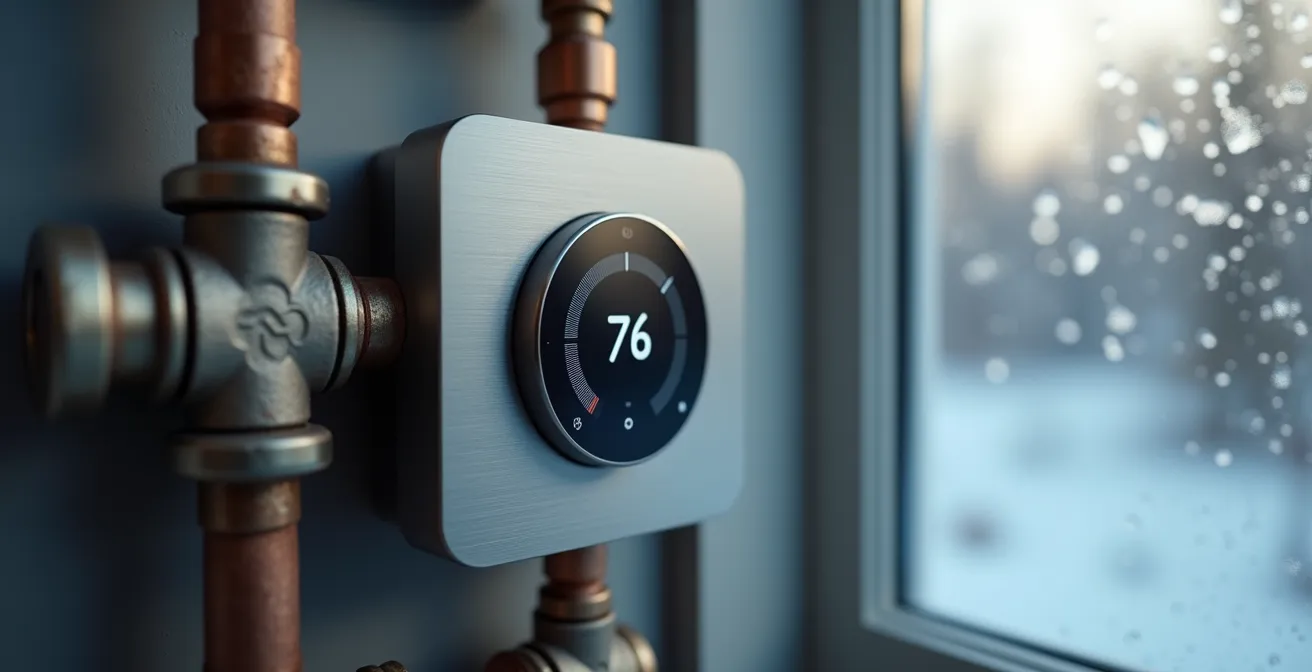
As shown in the image, smart home technology offers a robust solution. A smart thermostat can alert you on your phone if the cottage temperature drops to a critical level, and a smart water shut-off valve with leak detectors can automatically stop the water flow the moment a leak is sensed. These systems provide a level of active monitoring and rapid response that an insurer views very favorably, as it bridges the gap of physical vacancy.
Why “No Signs of Forced Entry” Can Deny a Cottage Theft Claim?
Imagine this scenario: you arrive at your cottage to find your television, electronics, and tools are gone. You call your insurer to file a theft claim, but it’s denied because there are no signs of a break-in—no broken windows, no pried-open doors. This is a shocking and frustrating reality for many second home owners, and it hinges on a critical policy distinction between “burglary” and “theft.” In the world of insurance, these are not interchangeable terms.
Most standard policies are designed to cover burglary, which is defined by the presence of physical evidence of forced entry. This evidence proves that an unlawful entry occurred. “Theft” without forced entry, on the other hand, falls into a grey area often labeled as “mysterious disappearance.” From an underwriter’s perspective, a mysterious disappearance raises a red flag for moral hazard—the possibility that the claim is fraudulent or the result of the owner’s extreme negligence (e.g., leaving a door wide open). While Statistics Canada reported over 130,000 breaking and entering incidents, insurers are equally concerned about losses where the circumstances are unclear.
The distinction is a risk management tool. By requiring proof of force, insurers protect themselves from paying for items that were simply lost, misplaced, or even stolen by someone who had legitimate access to the property, like a guest or a service provider. The following table breaks down how these scenarios are typically viewed.
| Coverage Type | Evidence Required | Typical Coverage |
|---|---|---|
| Burglary | Physical signs of forced entry | Usually covered |
| Theft without forced entry | No physical damage | Often excluded as ‘mysterious disappearance’ |
| Theft by authorized person | Access was permitted | Requires special endorsement |
To ensure you are protected, the lesson is clear: your cottage must be a fortress. Use high-quality locks on all doors and windows, and always ensure they are secured when you leave. Consider installing a security system with door/window sensors that can provide a digital record of an unauthorized entry, which can serve as an alternative form of proof even if physical damage is minimal.
Hiring a Local Teen to Mow: Are You Liable for Their Injury?
It seems like a harmless, neighborly thing to do: you pay a local teenager cash to mow the lawn or clear leaves at your cottage while you’re away. It’s convenient for you and provides a small job for them. However, from a liability perspective, this informal arrangement is fraught with risk. If that person is injured on your property while working, you could be held personally liable for their medical bills and other damages, and your standard cottage insurance policy may not cover you.
The issue lies in how the relationship is classified. Even without a formal contract, a court could determine that the person you hired was a “de facto employee.” Standard homeowner’s liability coverage is designed for social guests (like a friend tripping on a step), not for injuries sustained by employees in the course of their work. Worker injuries fall under the domain of commercial or workplace liability, an exposure your personal policy is not priced to cover. An insurance policy may help protect your cottage, but it often has specific exclusions for injuries to people considered employees, formal or otherwise.
To an underwriter, hiring uninsured, informal help is a significant and unassessed liability risk. The proper way to protect yourself is to transfer that risk. This means exclusively hiring professional services that carry their own business liability insurance. This ensures that if one of their workers is injured on your property, the claim goes against their policy, not yours.
Action Plan: Safe Hiring for Property Maintenance
- Always hire insured professional services that carry their own comprehensive business liability insurance.
- Request a valid Certificate of Insurance (COI) from the service provider before any work begins.
- If possible, verify that the COI can list your property as an “additional insured” for the duration of the job.
- Keep digital or physical copies of all invoices and insurance documentation for your records.
- Avoid cash payments. Use traceable methods like checks or e-transfers, which create a clear record of hiring a legitimate business.
While it might cost a bit more than a cash-in-hand deal, hiring an insured professional is the only way to ensure you are not personally exposed to a potentially devastating liability claim. It’s a critical part of managing your responsibilities as a property owner.
Friends and Family: When Does “Letting Them Use It” Become a Rental Risk?
Your cottage is a place for making memories, and that often means sharing it with friends and family. However, the line between casual, non-commercial use by guests and short-term rental activity can be blurrier than you think. Crossing that line without informing your insurer constitutes a “material change in risk,” which can void your entire policy. Letting a friend use the cottage for a weekend is one thing; letting them use it for a week in exchange for “covering the utility costs” could be interpreted by your insurer as business activity.
As Baldwin Insurance notes, the moment your property generates income, its risk profile changes. As they state, ” If you rent out your second home, you might need extra coverage to protect against tenant-related risks.” Tenants, even if they are friends, do not have the same vested interest in protecting your property as you do. The risk of both property damage and liability incidents increases. A guest slipping on a wet floor is a standard liability claim; a paying tenant slipping on the same floor can lead to a more complex commercial liability lawsuit.
Any form of compensation can be problematic. This doesn’t just mean direct payment. If a friend offers to do repair work in exchange for a week’s stay, or if you ask multiple family members to “chip in” to an “expense fund,” an underwriter could argue that this is a commercial transaction. The safest approach is to maintain a strict separation. If you allow guests, it should be entirely gratuitous. If you decide to rent, even occasionally on platforms like Airbnb or VRBO, you must speak to your insurer. You will likely need to switch to a specific rental or commercial policy, which, while more expensive, provides the correct coverage for that activity.
When Is Actual Cash Value Acceptable for a Vacation Cottage?
When you purchase insurance, one of the most fundamental choices you’ll make is between Actual Cash Value (ACV) and Replacement Cost coverage. This decision directly impacts how much you would be paid after a major loss, like a fire. For a primary home, Replacement Cost is almost always the standard. For a second home, however, an ACV policy is often presented as a cheaper alternative. Understanding the trade-off is crucial.
Replacement Cost coverage agrees to pay the full cost to rebuild your cottage to its prior state with materials of like kind and quality, without any deduction for depreciation. If your 10-year-old roof is destroyed, you get a brand-new roof. Actual Cash Value, on the other hand, pays you the replacement cost *minus* depreciation. For that 10-year-old roof with a 20-year lifespan, you might only get 50% of the cost of a new one. This can leave you with a significant out-of-pocket expense to complete the repairs.
So when is an ACV policy ever acceptable? It can be a calculated choice for a budget-conscious owner of an older cottage who has the financial reserves to cover the depreciation gap in the event of a claim. It might also be the only option for a very old or unique property that is difficult to value. However, with the rising frequency of severe weather, this gamble is becoming riskier. According to Matic Insurance, ” Wind and hail damage accounted for 42% of all insured home losses between 2018 and 2022,” making it the top cause of claims. An ACV policy on a property with an aging exterior could be financially devastating after a major storm.
This table from a resource by Foremost Insurance outlines the core differences:
| Coverage Type | What You Receive | Best For |
|---|---|---|
| Actual Cash Value (ACV) | Cost minus depreciation | Budget-conscious owners who can absorb gaps |
| Replacement Cost | Full rebuild cost without depreciation | Properties with mortgages or unique features |
| Agreed Value | Pre-determined full amount | Historic or hard-to-value properties |
Ultimately, if your cottage has a mortgage, the lender will almost certainly require Replacement Cost coverage to protect their investment. For everyone else, choosing ACV should be a deliberate financial decision, made with a full understanding of the potential shortfall you would face.
Key Takeaways
- Your policy is a contract of active duties; failure to perform them (like regular, documented visits) can void coverage.
- Insurers distinguish between “burglary” (with forced entry) and “mysterious disappearance,” often excluding the latter.
- Any compensation for use of your property, even “chipping in for expenses,” can classify the use as commercial, creating a material change in risk.
How to Guarantee Policy Adherence During Long Absences from Home?
Understanding the rules is one thing; proving you followed them is another. The key to ensuring your insurance policy remains valid during long absences is to be proactive, diligent, and meticulous in your record-keeping. You need to build a file that demonstrates, beyond any doubt, that you have met all your obligations as an insured party. This isn’t about mistrust; it’s about good governance and removing any ambiguity that could complicate a future claim.
The first and most critical step is communication. Before a planned long absence, call your broker or insurance agent. Discuss your plans and ask them to walk you through the specific vacancy clauses in your policy. What is the exact frequency of visits required? What qualifications must the designated visitor have? What are the requirements for winterization? After the call, send a follow-up email summarizing the conversation. This creates a written record of the guidance you received, which can be invaluable later.
With homeowners having seen an average rate surge of 17.4% for new policies, ensuring you get the value from your premium is paramount. Your strategy should be to create a “compliance folder” for your cottage. This folder, whether physical or digital, will be the central repository for all documentation related to your policy adherence. It is the ultimate proof of your active management.
Action Plan: The Pre-Departure Insurance Compliance Checklist
- Call your insurance agent to review all vacancy clauses and documentation requirements for your specific policy.
- Send a follow-up email to your agent summarizing the conversation to create a paper trail of the instructions you were given.
- Formally arrange for property checks every 48-72 hours with a trusted, competent person and provide them with a detailed checklist.
- Install and test risk mitigation technology like security systems, smart thermostats, and water leak detectors if possible.
- Create your compliance folder: fill it with visitation logs, time-stamped photos from each visit, and copies of all communications with your insurer.
- Proactively share your absence and supervision plan with your insurer to build goodwill and demonstrate your diligence.
By adopting this systematic approach, you shift from being a passive policyholder to an active risk-management partner. You are not just hoping for the best; you are creating the conditions for a successful claim by leaving no doubt that you have fulfilled your end of the insurance contract.
Frequently Asked Questions on Why Second Home Insurance Costs More for Less Coverage?
When does guest use become rental activity?
Rental property insurance comes into play when you use your second property as a rental home for others. This exposes you to greater risk, liability, and potential loss of rental income. The moment you begin accepting any form of compensation, you are likely engaging in rental activity from an insurer’s point of view.
What if I ask guests to ‘help with expenses’?
Any form of compensation, including contributions towards utilities, cleaning fees, or even non-monetary bartering (like offering a stay in exchange for repair work), can be interpreted by an insurer as business activity. This constitutes a material change in risk and could void your standard homeowner’s policy.
How can I protect myself when letting friends use my cottage?
The safest way is to ensure the use is purely gratuitous (no payment or compensation of any kind). For added clarity, you can create a simple, informal guest agreement that outlines the rules of the property (e.g., no parties, lock-up procedures) and includes a statement confirming that their stay is a non-commercial, friendly arrangement and not a rental.