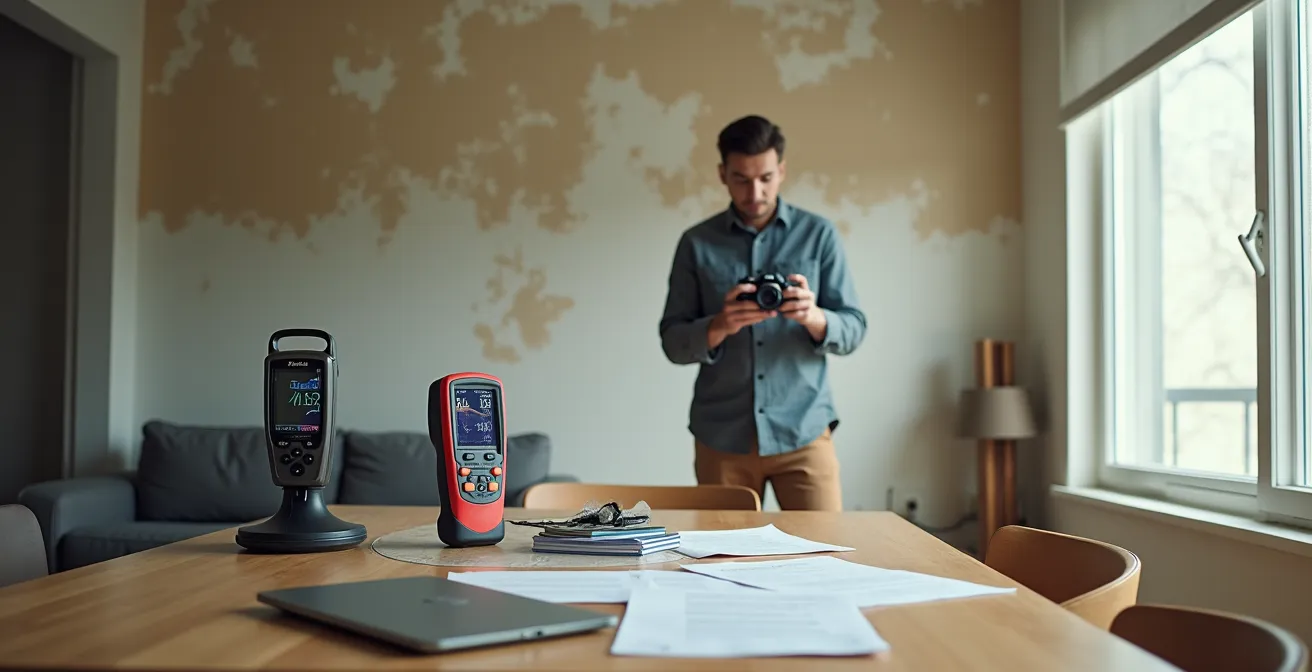
Most homeowners believe the severity of water damage dictates the insurance payout; the reality is that the claim’s success hinges entirely on the *narrative of its origin*.
- The specific words you use—like “sudden burst” versus “gradual leak”—are more critical than the volume of water in your basement.
- Insurers separate water damage into two categories: preventable maintenance issues (denied) and unforeseeable accidents (covered).
Recommendation: Immediately shift your focus from documenting the damage to documenting the *cause and timeline* of the event to build an undeniable case for a “sudden and accidental” occurrence.
Discovering water in your basement or a spreading stain on your ceiling triggers immediate panic. Your first thought is the cost and cleanup, quickly followed by the hope that your homeowner’s insurance will cover it. Many policyholders assume that “water damage” is a clear-cut category of coverage. They meticulously document the soaked carpets and ruined furniture, only to be met with a frustrating denial. The common advice to “document everything” and “call your insurer right away” is fundamentally incomplete. It misses the single most critical factor that determines a claim’s outcome.
The insurance industry doesn’t operate on the visual evidence of damage alone. It operates on a strict interpretation of policy language, centered on one core principle: distinguishing a sudden, accidental event from a gradual failure caused by a lack of maintenance. A pipe that catastrophically bursts is an accident. A slow drip that seeps through drywall over months is a maintenance issue. Your insurer’s entire investigation is designed to place your event into one of these two boxes.
But what if the line between the two is blurry? This is where claims become contested. The key to navigating this complex process is not just to prove that damage occurred, but to construct a precise and undeniable narrative that frames the incident as a covered peril. This guide moves beyond generic advice to give you the technical understanding and strategic language of a restoration expert. We will dissect the subtle distinctions that adjusters look for, from the source of the water to the timeline of its discovery, providing a clear framework to secure the coverage you are entitled to.
This article provides a technical deep dive into the critical aspects of a water damage claim. By understanding the insurer’s perspective on each point, you can effectively prepare and present your case for approval.
Summary: Navigating Contested Water Damage Insurance Claims
- Why Rain Entering a Window Is Treated Differently Than a Burst Pipe?
- How to Mitigate Water Damage Immediately to Preserve Your Claim Rights?
- Drying vs Replacing: Which Strategy Does Insurance Prefer?
- The Seepage Mistake That Turns a Valid Claim into a Denial
- When Does Water Damage Become a Mold Exclusion: The 48-Hour Clock?
- Why the Definition of “Sudden” Matters More Than the Damage Amount?
- Why Hidden Leaks Are Sometimes Covered While Visible Ones Are Not?
- How to Ensure Your “Sudden Burst” Claim Is Approved?
Why Rain Entering a Window Is Treated Differently Than a Burst Pipe?
From a homeowner’s perspective, water is water. Whether it comes from a ruptured supply line in the wall or is driven by wind through a window seal, the result is a soaked, damaged interior. For an insurer, however, the origin of the water is the defining factor that separates a straightforward approval from a likely denial. The core issue is the concept of “concurrent causation”—when a covered event (like wind) and an uncovered issue (like poor maintenance or wear and tear) contribute to the same loss. A burst pipe is a singular, internal failure. Rain entering a window introduces external factors and shifts the burden of proof squarely onto the policyholder.
With a burst pipe, the damage itself is often sufficient proof of a “sudden and accidental” event. The insurer’s primary concern is whether the pipe froze due to negligent lack of heat, but otherwise, coverage is common. When rain is the cause, you must prove that the water only entered because a covered peril created the opening. For example, you must demonstrate that high winds (a covered peril) broke the window or tore off siding, allowing the water in. If the water entered through a pre-existing gap, a deteriorating seal, or a poorly maintained frame, the insurer will classify it as a maintenance issue and deny the claim.
This distinction is critical and dramatically impacts claim outcomes. The documentation required for a rain-driven water claim is far more extensive, involving weather reports, structural assessments, and a clear timeline connecting the storm to the water’s entry. The following table breaks down how insurers view these two common scenarios, illustrating why the source of the water changes everything.
As this comparative analysis from insurance providers shows, the burden of proof is fundamentally different depending on the water’s source.
| Coverage Aspect | Burst Pipe | Rain Through Window |
|---|---|---|
| Burden of Proof | Damage itself is proof | Must prove covered peril caused opening |
| Typical Coverage Rate | 95% approved | 40% approved |
| Documentation Required | Photos of burst pipe | Weather reports, structural assessment, timeline |
| Common Denial Reason | Lack of heat maintenance | Pre-existing deterioration |
| Concurrent Causation Risk | Low | High (wind + neglect) |
How to Mitigate Water Damage Immediately to Preserve Your Claim Rights?
Once water is discovered, your policy contains a “Duties After a Loss” clause that legally requires you to take reasonable steps to prevent further damage. This is not just a suggestion; it’s a condition of your coverage. Failure to act swiftly can lead an insurer to argue that subsequent damage, like advancing mold or structural rot, is a result of your negligence, not the original event. The immediate actions you take are not just about cleanup—they are about preserving your claim. However, a common mistake is to confuse DIY cleanup with professional mitigation.
While you should immediately stop the water source if possible, remove standing water with a shop-vac, and move sensitive contents, professional mitigation goes much further. It involves creating a stable, dry environment using industrial-grade dehumidifiers and air movers to control atmospheric moisture. Crucially, it also involves comprehensive documentation. Professionals create a detailed record, including moisture readings, thermal imaging reports showing water migration inside walls, and a detailed mitigation log. This data becomes indispensable evidence that you fulfilled your duties and provides a baseline for what was damaged by the initial event.
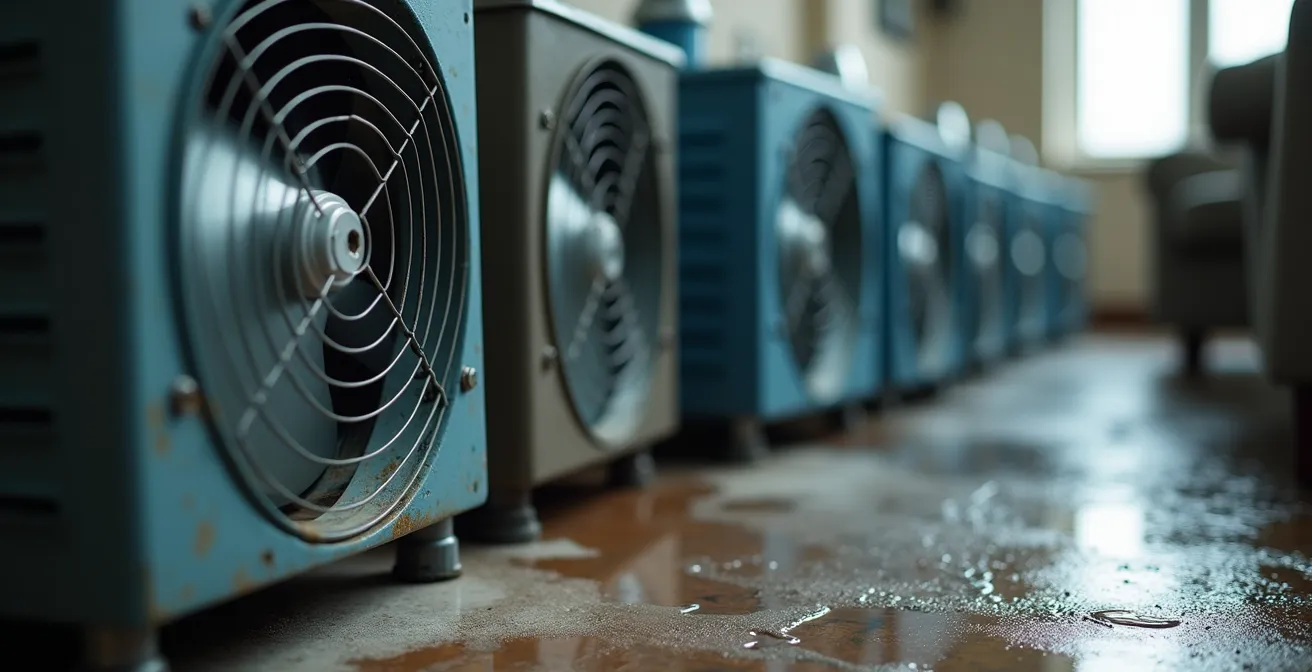
This professional documentation directly impacts the financial outcome of your claim. In fact, construction industry data confirms that claims handled by IICRC-certified restoration companies are more likely to be approved and for higher amounts. As an analysis of recent claims shows, homeowners who engaged professionals for mitigation saw settlements averaging 35% higher than those who attempted DIY drying, primarily because their documentation left no room for the insurer to dispute the scope of the damage.
Drying vs Replacing: Which Strategy Does Insurance Prefer?
One of the first major points of contention between a homeowner and an insurance adjuster is the question of restoration versus replacement. From a purely financial standpoint, an insurer will almost always prefer to dry and repair damaged materials rather than pay for their complete replacement. The adjuster’s initial estimate will often be based on a “drying-in-place” strategy. However, this cost-saving approach is often technically inappropriate for many modern building materials and can lead to future problems like hidden mold and structural degradation.
As a restoration expert, it’s understood that not all materials can be salvaged. The IICRC (Institute of Inspection, Cleaning and Restoration Certification), which sets the industry standard, is clear that certain materials are non-salvageable after significant water exposure. Porous and composite materials like MDF particle board, most insulation, and standard drywall act like sponges. They lose their structural integrity and cannot be reliably dried to prevent microbial growth. While materials like solid hardwood and traditional plaster walls can often be saved, anything that swells, delaminates, or retains moisture deep within its structure is a candidate for removal.
Arguing for replacement over drying requires a technical, evidence-based approach. You cannot simply state that you want a new floor; you must prove that drying is an insufficient remedy. This involves building a case with specific data points that demonstrate the material is saturated beyond the point of viable restoration. Your contractor or mitigation company is your greatest ally in this process, providing the technical documentation needed to counter the insurer’s preference for a cheaper, but often inadequate, solution.
Action Plan: Building Your Case for Replacement Over Drying
- Document pre-loss condition: Provide photos showing the original quality, custom features, or seamless finishes that a patch-and-dry approach cannot replicate.
- Obtain deep moisture readings: Use a probe meter to show that saturation levels deep within the material (e.g., subfloor, drywall core) exceed the manufacturer’s or industry’s acceptable limits for drying.
- Request thermal imaging reports: Use thermal scans to document the migration of moisture into adjacent, unseen areas, proving the damage is more extensive than it appears on the surface.
- Present a mold risk assessment: Argue that inadequate drying of porous materials creates a significant risk of future mold growth, which would represent a larger, future liability for the insurer.
- Secure comparative contractor estimates: Present a detailed estimate for removal and replacement alongside the insurer’s drying estimate, highlighting the long-term costs and risks associated with a failed drying attempt.
The Seepage Mistake That Turns a Valid Claim into a Denial
The single most damaging word you can use when reporting a water damage claim is “leak” or “seepage.” These terms immediately signal to an insurer a gradual, ongoing problem—a clear maintenance issue that falls outside the “sudden and accidental” coverage provision. A homeowner who calls their insurer and says, “I’ve had a slow leak under my sink,” or “I’ve noticed seepage in my basement for a while,” has likely sealed the fate of their claim before an adjuster even visits. The narrative you present in your initial report is paramount.
Your policy is designed to cover an unforeseen event, not to pay for the consequences of deferred maintenance. The language you use frames the event. “The pipe burst” implies a sudden failure. “I discovered a large area of water” focuses on the moment of discovery, not the duration of the cause. This is not about being dishonest; it is about being precise. You may not know how long a hidden pipe was failing, but you know exactly when you discovered the resulting flood. Your claim is based on the sudden manifestation of damage, not on speculation about its origin timeline.
This is where the principle of “ensuing loss” can be a claim-saver. In some cases, an initial uncovered event (like gradual seepage) can cause a subsequent, covered event. For example, legal experts report cases where foundation seepage (uncovered) was denied, but coverage was approved for the “ensuing loss” when a water-logged beam suddenly collapsed (a covered event). The focus shifted from the original water source to the sudden structural failure it caused. This advanced strategy requires careful documentation and a precise argument, but it demonstrates how a denied claim can be transformed by focusing on a separate, sudden event that results from the initial problem. The language used in this process is critical, as shown below.
The words used to describe the event in the initial report can pre-determine the outcome, as this breakdown of claim language illustrates.
| Scenario | Denial Language | Approval Language |
|---|---|---|
| Pipe Failure | ‘Has been leaking for weeks’ | ‘Pipe fitting suddenly failed’ |
| Water Discovery | ‘Gradual seepage over time’ | ‘Discovered large area of water’ |
| Timeline | ‘Ongoing moisture problem’ | ‘Occurred while on vacation’ |
| Visibility | ‘Should have noticed earlier’ | ‘Hidden behind wall, no prior signs’ |
When Does Water Damage Become a Mold Exclusion: The 48-Hour Clock?
Many insurance policies contain a mold exclusion or a “sub-limit,” which caps coverage for mold damage at a low amount (e.g., $5,000 or $10,000). This often becomes a point of contention. If mold is found after a water loss, the insurer may try to classify the entire claim under this restrictive limit. The homeowner’s goal is to keep the claim classified as “water damage,” with mold being an integral part of that damage, not a separate event. A common myth revolves around a strict “48-hour clock,” suggesting that any mold appearing after two days is automatically the homeowner’s fault. This is an oversimplification.
The reality is more nuanced. While mold can begin to grow within 24-48 hours in ideal conditions (moisture, a food source like drywall, and appropriate temperature), the true issue for insurers is not the clock itself. It’s about causation and mitigation. Was the mold a direct and immediate result of a covered water event? And did the homeowner take reasonable and timely steps to mitigate the water damage, thus preventing or limiting mold growth? If you report a claim immediately and hire a professional mitigation company that starts drying procedures within a day, it is very difficult for an insurer to argue you were negligent.
This is why the documentation from your mitigation company is so vital. Daily moisture readings, photos, and equipment logs prove you acted responsibly. If mold still develops on a saturated material that is awaiting adjuster approval for removal, your mitigation records show the mold is part of the primary water loss, not a new problem caused by delay. The focus should be on demonstrating immediate and appropriate action.
The real issue for insurers is not the clock, but whether the mold is a direct result of a covered water event and if the homeowner took reasonable and timely steps to mitigate it.
– United Policyholders, Mold Contamination Insurance Coverage Guidelines
Why the Definition of “Sudden” Matters More Than the Damage Amount?
A homeowner might assume that a small, $2,000 claim would be easier to get approved than a catastrophic, $50,000 claim. This is a fundamental misunderstanding of how insurance operates. An adjuster is not primarily concerned with the total dollar amount of the loss; they are concerned with whether the loss is covered by the policy at all. A $50,000 claim from a “sudden and accidental” event will be paid, while a $2,000 claim from a gradual leak will be denied. The entire focus of the investigation is on establishing the timeline and nature of the event.
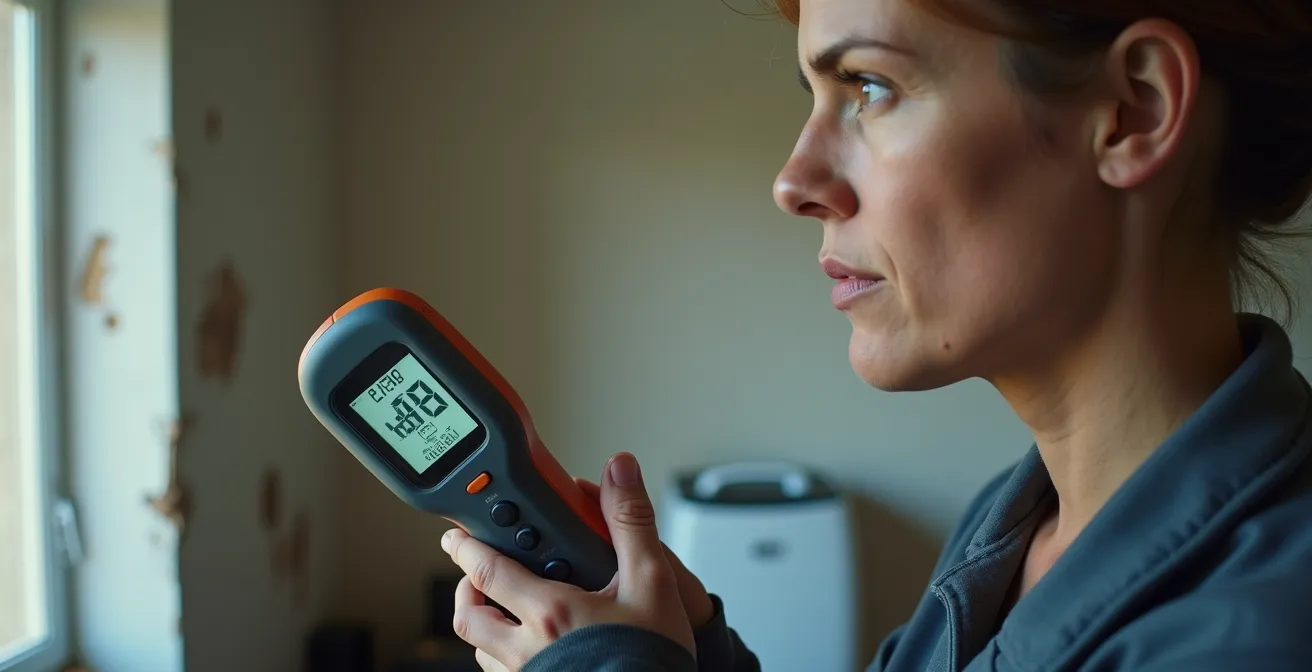
The word “sudden” is the gatekeeper of coverage. To qualify, the event must be swift and unexpected, not slow and progressive. The challenge is proving this when the damage occurs out of sight. How do you prove a pipe inside a wall burst “suddenly” if you were at work? The key is to establish a tight, defensible timeline of discovery. The best evidence is a confirmed “last known dry” moment. For example, if you were away for a weekend, your flight records and hotel receipts create a definitive window during which the damage must have occurred. This makes it nearly impossible for an insurer to argue it was a long-term, gradual issue.
One of the clearest examples involves homeowners returning from vacation. Insurance claim data shows these claims have significantly higher approval rates precisely because the timeline is non-negotiable. In one documented case, a homeowner returned from a week-long trip to find extensive flooding. By providing travel records, they proved the event happened within a confined seven-day window, demonstrating a “sudden” occurrence. The $50,000 claim was approved despite the high value because the narrative was irrefutable. Your ability to build this “sudden damage” narrative is therefore your most powerful tool.
- Use action words in your initial report: ‘burst,’ ‘ruptured,’ or ‘failed catastrophically’ instead of ‘leaked.’
- Establish an absence timeline: Document when you last saw the area in a dry, undamaged state, using photos or even witness statements if available.
- Identify a potential triggering event: If possible, connect the damage to a specific moment, such as a recent storm, a period of freezing temperatures, or a municipal water pressure spike.
- Emphasize the shock of discovery: Describe the immediate and significant visible impact you witnessed upon finding the damage.
- Avoid speculation: Never guess or offer theories about how long the problem might have been developing. State only the facts you know.
Why Hidden Leaks Are Sometimes Covered While Visible Ones Are Not?
It seems counterintuitive: wouldn’t an obvious, visible leak be easier to claim than one hidden behind a wall? In the world of insurance, the opposite is true. The visibility of a leak is directly tied to the concept of homeowner negligence and maintenance responsibility. An insurer’s logic is that if you can see a problem, you have a duty to fix it. Ignoring it constitutes neglect, and the resulting damage is therefore not “accidental.”
A slow drip from the P-trap under your kitchen sink, for instance, is clearly visible. Water stains, rust, or mineral deposits are clear warning signs. If that slow drip is ignored for months and eventually causes the cabinet floor to rot and collapse, the insurer will deny the claim. They will argue that you had ample opportunity to perform a simple, inexpensive repair but failed to do so. The damage was not accidental; it was the foreseeable consequence of inaction. This is considered a maintenance issue, which is explicitly excluded from coverage.
In contrast, a pipe fitting that fails inside a wall cavity offers no such warning signs. The homeowner has no reasonable way of knowing a problem is developing. There is no opportunity to perform maintenance on a pipe you cannot see or access. When that pipe finally bursts and floods the room, the event is genuinely “sudden and accidental” from the homeowner’s perspective. The discovery of the damage is the event itself. This is why hidden leaks have a much higher approval rate. The claim often includes the necessary “tear-out” costs to access and repair the pipe, as this is part of rectifying the covered loss.
| Factor | Hidden Leak (Often Covered) | Visible Leak (Often Denied) |
|---|---|---|
| Location | Inside walls, under slab, above ceiling | Under sinks, visible pipes, accessible areas |
| Prior Warning Signs | None detectable | Drips, stains, rust visible |
| Maintenance Opportunity | No reasonable access | Regular inspection possible |
| Tear-Out Coverage | Usually included for access | Rarely covered |
Key Takeaways
- The words you use in your initial claim report (“burst” vs. “leak”) can determine the outcome.
- Immediate, professional mitigation is not just for cleanup; it’s a required step to preserve your claim rights and document the loss.
- The battle is not over the cost of damage, but over the narrative of its origin: “sudden and accidental” versus “gradual and maintenance-related.”
How to Ensure Your “Sudden Burst” Claim Is Approved?
Successfully navigating a water damage claim requires a strategic, organized, and proactive approach from the very first hour. It is not a passive process of waiting for an adjuster to tell you what is covered. It is an active process of building an undeniable case. By combining immediate, professional mitigation with a meticulously crafted narrative of a “sudden and accidental” event, you shift the dynamic from a contested claim to a straightforward approval. Every piece of evidence, from a plumber’s report on the failed component to a timeline of your family’s vacation, serves to eliminate any argument for gradual damage or negligence.
For complex or large-scale losses, homeowners should not underestimate the complexity of this process. In many cases, hiring a public adjuster—a licensed professional who works for the policyholder, not the insurance company—can be a decisive factor. Their expertise in policy language and claim negotiation can level the playing field. In fact, data consistently shows that policyholders who use public adjusters see significantly better outcomes, with one analysis finding an average increase in claim settlements of 747%. This demonstrates the financial value of expert advocacy.
Ultimately, a successful claim is a well-documented one. The following blueprint outlines the critical steps to take from the moment you discover water, designed to build a claim package that is ready for approval on day one.
- Hour 1-2: Stop the water source immediately. Call your insurer’s 24/7 hotline (do not use a web form or email for the initial report). Verbally report a “sudden pipe burst” or “catastrophic failure,” not a “leak.”
- Hour 2-6: Call an IICRC-certified professional mitigation company to begin emergency services. Photograph and video everything before they touch it, and continue documenting their process. Create a written timeline of events starting with the moment of discovery.
- Day 1: If relevant, download weather reports from the day of the incident. Secure any broken parts, like a failed pipe fitting, in a sealed bag—this is crucial evidence. If neighbors can attest to a specific event (like a loud bang), ask for a brief written statement.
- Day 2-3: Schedule an assessment with an independent plumber or engineer to get a third-party report on the cause of failure. Compile all your photos, videos, timelines, receipts, and reports into a single, organized digital folder.
- Day 4-7: When you meet the insurance adjuster, present them with your complete evidence package. Be polite but firm. After the meeting, send a follow-up email summarizing your understanding of the discussion and the agreed-upon next steps.
By treating your claim as a technical case to be proven rather than a request to be granted, you fundamentally change your position and maximize your chances of a fair and complete settlement.