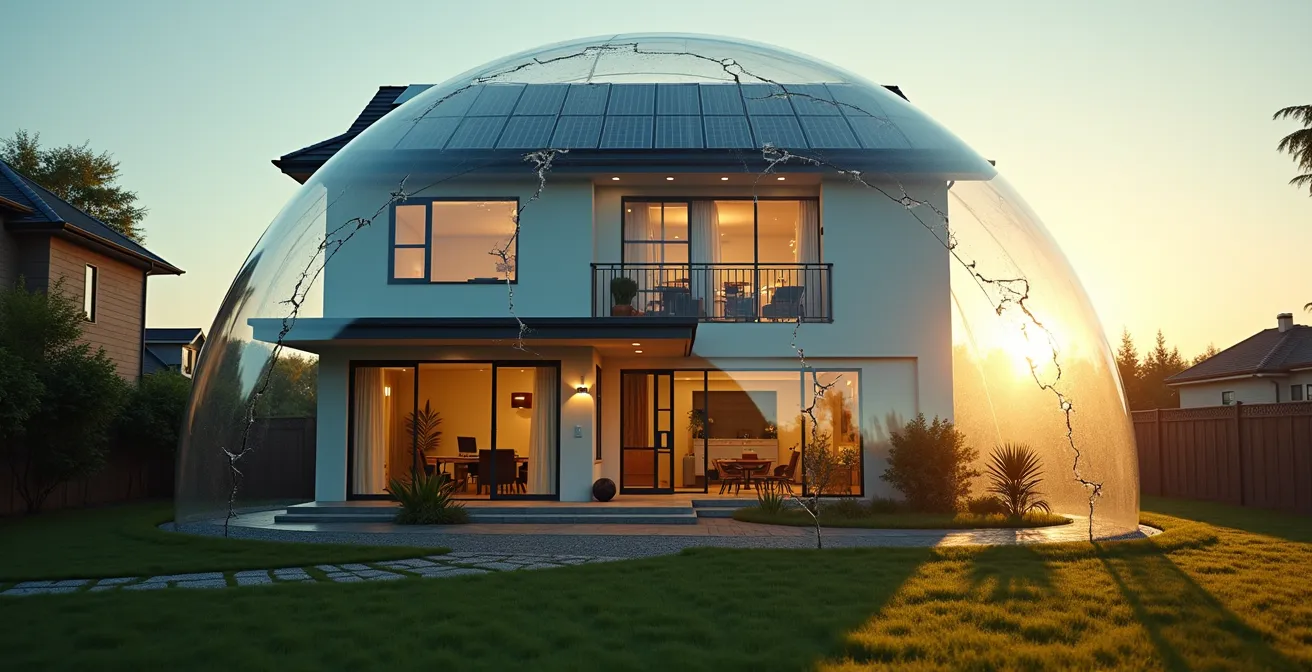
Your standard homeowner’s insurance is likely built on an outdated model, creating a structural mismatch with the financial realities of your renovated, tech-filled home.
- Standard policies often use “Actual Cash Value” for your belongings, which pays you a depreciated amount, not what it costs to buy new items.
- Critical modern risks, like equipment breakdown, sewer backup, and sufficient coverage for home office equipment, are typically excluded by default.
Recommendation: Proactively review your policy’s sub-limits and endorsements, and strongly consider upgrading from a standard HO-3 to a more comprehensive HO-5 “all-risk” policy.
As a homeowner, you probably have insurance. It might have been a requirement for your mortgage, or perhaps you bought a standard policy online, checked the box, and assumed you were protected. The common belief is that if a disaster strikes, your insurance will make you whole again. This assumption, however, is one of the most significant financial risks a modern homeowner can take.
The issue isn’t just about reading the fine print or knowing about common exclusions like floods and earthquakes. The problem is more fundamental: the very architecture of most “standard” homeowner policies, like the common HO-3 form, was not designed for the way we live today. It struggles to account for the financial impact of a home office, expensive electronics, smart home systems, and the true cost of rebuilding after significant inflation. This creates a dangerous structural mismatch between what you think you have and the coverage you actually need.
But what if the key wasn’t just to increase your coverage amount, but to change the *type* of coverage you have? This article will dissect the anatomy of a standard policy to expose its inherent weaknesses. We will move beyond the platitudes and give you a clear, objective analysis of the specific gaps that put your finances at risk, why premium policies are often a necessity rather than a luxury, and how to ensure your coverage truly aligns with the value of your modern home and lifestyle.
To navigate these complexities, this guide breaks down the critical differences between policy types, the common mistakes that can void your coverage, and the essential questions you must ask your insurer. Follow along to understand the specific vulnerabilities in your current policy and the concrete steps to secure proper protection.
Summary: The Critical Flaws in Standard Home Insurance Coverage
- What Does a Standard HO-3 Policy Actually Cover in Plain English?
- The 5 Risks That Standard Policies Explicitly Exclude in Fine Print
- Standard vs Premium: Is the Extra $200/Year Worth the Upgrade?
- The Danger of Buying Insurance Online Without Customizing the Standard Form
- When to Notify Your Insurer: The renovation Mistakes That Void Standard Coverage
- Why “All-Risk” Policies Are Safer Than Named Perils for Old Homes?
- Basic or Broad Form: Which Offers the Minimum Acceptable Security?
- Why Opting for Replacement Cost Value Is the Only Viable Choice?
What Does a Standard HO-3 Policy Actually Cover in Plain English?
A standard HO-3 policy is the most common type of home insurance in the United States. It’s often considered a good balance of coverage and cost, but understanding its structure is crucial. An HO-3 is a hybrid policy. It provides “open perils” coverage for your home’s structure (the dwelling) but only “named perils” coverage for your personal belongings. This distinction is the source of many coverage gaps.
“Open perils” for your dwelling means the structure is covered against all forms of damage *except* for those specifically listed as exclusions in the policy (like flood or earthquake). This is broad protection. However, your personal property—furniture, electronics, clothing—is covered on a “named perils” basis. This means it is only protected against a specific list of 16 events, such as fire, theft, or windstorm. If your laptop is damaged by a power surge that isn’t on that list, you are not covered.
Furthermore, standard policies have sub-limits for specific categories of items. For instance, there’s often a cap of $1,500 for electronics and $2,500 for business property stored at home. For anyone working remotely with professional-grade equipment, this is woefully inadequate. The policy was not designed for a world where the home is also the office. This is a classic example of the structural mismatch between old policy forms and modern lifestyles.
Your 5-Point Coverage Reality Check
- Review dwelling coverage: Your limit should equal 100% of today’s rebuilding costs, not the market value of your home. This may require a significant increase from your original policy amount.
- Check personal property sub-limits: Identify low caps on categories like electronics, jewelry, or business equipment and compare them to the actual value of your items.
- Verify Loss of Use coverage: Standard policies cover additional living expenses if you’re displaced, but they typically do not cover lost income if you can’t run your home-based business.
- Understand your perils: Remember that your house structure (open perils) has better protection than your belongings (named perils). Accidental damage to your possessions is likely not covered.
- Calculate your true coverage: Factor in your deductible, which can be a percentage (1-2%) for specific events like hurricanes, to understand your actual out-of-pocket cost in a claim.
The 5 Risks That Standard Policies Explicitly Exclude in Fine Print
Every insurance policy has exclusions, but standard forms often leave homeowners exposed to common and costly modern risks. While most people know about exclusions for catastrophic events like floods, earthquakes, and war, other gaps are less obvious yet far more likely to occur. These exclusions highlight the policy’s inability to keep pace with contemporary homes and environments.
Here are five significant risks that your standard policy likely does not cover:
- Water Backup: Damage from a drain or sewer backing up into your home is almost universally excluded from standard policies. This is a common and expensive problem, and coverage must be added via a specific endorsement.
- Mold Remediation: While a policy might cover mold resulting from a covered peril (like a burst pipe), it often has a very low cap (e.g., $5,000) for remediation. Widespread mold issues are not fully covered.
- Wear and Tear / Lack of Maintenance: Insurance is for sudden and accidental events. It is not a home warranty. A 20-year-old roof that fails due to age or an old appliance that breaks down is not covered.
- Home-Based Business Liability: A standard policy provides personal liability, but if a client slips and falls at your home office, or if business inventory is destroyed, your policy will not respond. You need a separate business endorsement or policy.
- Equipment Breakdown: Modern homes are filled with complex systems like HVAC units, smart home controllers, and high-end appliances. If they fail due to a mechanical or electrical breakdown, the repair or replacement cost is not covered by a standard policy without a specific equipment breakdown endorsement.
These exclusions are not hidden in secret clauses; they are clearly stated but often overlooked. They represent a fundamental disconnect between the “all-purpose” nature of a standard policy and the specific, multifaceted risks of a modern property.
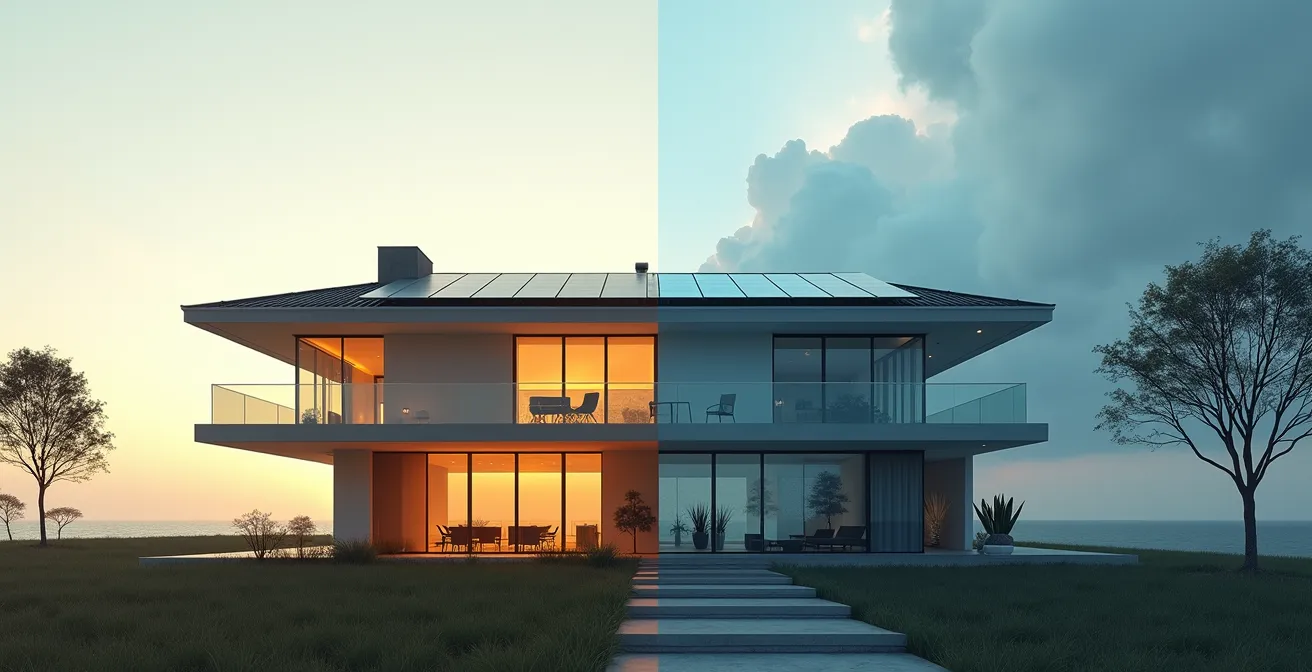
As the illustration suggests, what is inside your home is just as important as the structure itself, but standard policies treat them very differently. This gap in protection is where many homeowners face unexpected financial devastation.
Standard vs Premium: Is the Extra $200/Year Worth the Upgrade?
The two most common policy forms are the standard HO-3 and the premium HO-5. While they may seem similar, the differences are profound and directly address the “named perils” weakness of a standard policy. For a relatively small increase in premium—often just a few hundred dollars a year—an HO-5 policy provides a significant upgrade in protection that is especially valuable for owners of modern, well-maintained homes.
The single most important difference is how personal property is handled. As we’ve seen, an HO-3 covers your belongings only for a list of 16 specific perils. An HO-5 policy, by contrast, provides “open perils” coverage for both your dwelling and your personal property. This means your belongings are covered for everything *except* the specific exclusions listed in the policy. This shifts the burden of proof: with an HO-3, you must prove the loss was caused by a covered peril; with an HO-5, the insurer must prove it was caused by an excluded one.
Additionally, HO-5 policies typically include Replacement Cost Value (RCV) for personal property by default, whereas it is often an optional, extra-cost upgrade on an HO-3. This alone can mean a 40-60% difference in a claim payout for your belongings. For a homeowner with significant investments in furniture, electronics, and other valuables, this upgrade is not a luxury—it’s essential risk management.
The table below, based on an analysis of HO-3 versus HO-5 policies, clearly illustrates the gaps and why the upgrade is often a wise investment.
| Coverage Aspect | Standard HO-3 | Premium HO-5 | Gap Impact |
|---|---|---|---|
| Personal Property Coverage | Named Perils Only (16 specific risks) | Open Perils (all risks except exclusions) | $15,000+ gap on accidental damage |
| Valuation Method | Actual Cash Value (depreciated) | Replacement Cost Value | 40-60% value difference on claims |
| Coverage Complexity | You prove peril is covered | Insurer proves peril is excluded | Faster claims, fewer denials |
| Annual Premium Difference | Base rate | +$200-400 typically | ROI positive after one claim |
The Danger of Buying Insurance Online Without Customizing the Standard Form
In the digital age, purchasing insurance online with a few clicks is convenient, but it’s also a primary source of underinsurance. The “default-form danger” is real: online quoting tools often use public data about your home (like old tax records or real estate listings) to pre-fill your coverage amounts. This data is frequently outdated or inaccurate, failing to account for renovations, custom features, or current rebuilding costs.
When you accept a default online quote, you are often buying a policy based on a ghost version of your home. It might not include the finished basement you added, the high-end kitchen appliances you installed, or the correct square footage. An error in square footage, which can average 20%, can leave you tens of thousands of dollars short in a total loss scenario. The convenience of a quick purchase comes at the cost of accuracy and customization.
Moreover, these automated systems rarely prompt you to add crucial endorsements for modern risks. Coverage for sewer backup, equipment breakdown, or a home office is almost never included in a base-level online policy. You must know to ask for them and add them yourself. Without the guidance of a broker to ask probing questions about your lifestyle and home upgrades, you are essentially acting as your own underwriter—a role few are qualified to perform. Never auto-renew a policy without a thorough annual review to adjust for inflation and home improvements.
The ease of the transaction masks the complexity of the product. An insurance policy is not a commodity; it’s a complex legal contract that needs to be tailored to your specific financial situation. Relying on an algorithm to protect your single biggest asset is a significant and unnecessary gamble.
When to Notify Your Insurer: The renovation Mistakes That Void Standard Coverage
One of the most common and costly mistakes homeowners make is failing to inform their insurance company about renovations and upgrades. A home insurance policy is priced based on the risk and replacement cost of the property at the time the policy is written. When you make significant changes, you alter that risk profile. Failing to update your insurer can lead to claim denials or, in the worst-case scenario, void your coverage entirely.
This issue is widespread; an industry report found that 62% of Americans planned home remodeling projects that could impact their coverage. Any project that adds value to your home—like a new kitchen, a finished basement, or a bathroom addition—increases its replacement cost. If you don’t increase your dwelling coverage to match, you will be underinsured. If a fire destroys your home, the insurer is only obligated to pay up to your policy limit, leaving you to cover the cost of the new, more expensive additions out-of-pocket.
Even smaller upgrades require notification. Installing a swimming pool or a trampoline dramatically increases your liability risk. Adding a permanent wheelchair ramp or a stair lift for aging in place changes the home’s structure and value. As one expert points out, if you fail to raise your coverage limits after such modifications, you could be on the hook for the uncovered share after a total loss. Furthermore, if you undertake a major renovation without the proper permits, an insurer could deny a related claim on the grounds that the work was not up to code and created an uninsurable hazard.
The rule is simple: before, during, and after any renovation, talk to your insurance broker. A quick call can ensure your coverage is adjusted appropriately, preventing a catastrophic financial surprise down the line. Your policy must reflect the home you have today, not the one you bought years ago.
Why “All-Risk” Policies Are Safer Than Named Perils for Old Homes?
The distinction between “all-risk” (or “open perils”) and “named perils” coverage is one of the most important concepts in property insurance, yet it is widely misunderstood. For owners of any home, but especially those with unique or older features mixed with modern upgrades, an all-risk policy offers a fundamentally safer and more robust form of protection. The safety lies in the policy’s structure and where the burden of proof falls.
With a named perils policy, coverage only applies if the damage is caused by one of the specific perils listed in the contract (e.g., fire, wind, hail). If your property is damaged by something not on that list, there is no coverage. The burden is on you, the homeowner, to prove that the cause of loss was one of the named perils. This can be contentious and lead to denied claims for events that fall into a grey area.
In contrast, an all-risk policy works in reverse. It covers loss from all causes *except* for those specifically excluded in the policy. Here, the burden of proof shifts to the insurance company. To deny the claim, they must prove the loss was caused by an excluded event. This “guilty until proven innocent” approach for perils provides far broader protection. It covers freak accidents, unusual events, and unforeseen circumstances that would never make it onto a named perils list.
For a modern home that might have smart home technology, automated systems, or custom-built features, this is crucial. What happens if a software glitch in your smart thermostat causes your pipes to freeze? Is “software glitch” a named peril? Unlikely. With an all-risk policy, the damage would be covered unless a specific “cyber event” or “electronic malfunction” exclusion applies. It protects you from the unknown unknowns, which are increasingly common in our complex, tech-integrated homes.
Key Takeaways
- Standard HO-3 policies provide weaker “named perils” coverage for your belongings, creating significant gaps.
- Upgrading to an HO-5 policy provides “all-risk” coverage and shifts the burden of proof to the insurer, offering much broader protection.
- Opting for Replacement Cost Value (RCV) over Actual Cash Value (ACV) is critical to being made whole after a loss, as RCV does not factor in depreciation.
Basic or Broad Form: Which Offers the Minimum Acceptable Security?
While the standard HO-3 policy has its flaws, it is essential to understand that there are even more limited forms of coverage available. Basic (HO-1) and Broad (HO-2) forms offer lower premiums, but they come at the cost of dangerously inadequate protection for any modern home. Viewing them helps put the HO-3 in perspective as the absolute minimum acceptable baseline, not a comprehensive solution.
A Basic Form (HO-1) is the most restrictive, covering only 10 named perils. It excludes common events like the weight of ice and snow, falling objects, and water damage from plumbing. For a minimal monthly saving of perhaps $15-20, you expose yourself to tens of thousands of dollars in uncovered losses from very plausible events. This policy form is so inadequate that most insurers no longer even offer it.
A Broad Form (HO-2) is a step up, covering the same 16 named perils as an HO-3’s personal property coverage. However, unlike an HO-3, it does not provide “open perils” coverage for the dwelling. The structure of your home itself is only protected against the 16 listed events. This is a major downgrade. A strange accident or an unlisted event that damages your home’s structure would not be covered. With an estimated 50-70% of claims may be denied on basic forms due to unlisted perils, compared to the much lower rates for HO-3 and HO-5 policies, the risk is simply not worth the small savings.
For any homeowner today, neither of these forms provides an acceptable level of security. They are relics of a simpler time and are fundamentally misaligned with the risks and values of contemporary properties. An HO-3 should be considered the starting point, with the goal of upgrading to an HO-5 for true peace of mind.
Why Opting for Replacement Cost Value Is the Only Viable Choice?
Perhaps the single most important and financially impactful choice in a home insurance policy is the valuation method: Actual Cash Value (ACV) versus Replacement Cost Value (RCV). While ACV policies are cheaper, they are a recipe for financial disaster in a major claim. For any homeowner looking for true protection, RCV is the only viable option.
Actual Cash Value is defined as the cost to replace an item with a similar one, *minus depreciation*. Depreciation accounts for age, wear and tear, and obsolescence. This means that if your 10-year-old roof is destroyed, ACV will only pay you a fraction of its original cost. If your 5-year-old television and sofa are destroyed in a fire, you will receive a check for what those used items were worth, which is not nearly enough to buy new replacements.
Replacement Cost Value, on the other hand, pays the cost to replace the damaged item with a new, similar item of like kind and quality, *without deducting for depreciation*. It pays what it actually costs to make you whole again in today’s market. This is critical in an inflationary environment. With a cumulative increase in replacement costs of 55% since 2020, rebuilding a home or replacing its contents costs significantly more than it did just a few years ago. An ACV policy completely ignores this reality.
Choosing ACV to save a small amount on your premium is a classic example of being “penny wise and pound foolish.” You are betting that you will never have a significant loss. But the entire purpose of insurance is to protect you from that very event. Opting for Replacement Cost Value for both your dwelling and your personal property ensures that your policy can actually fulfill its promise when you need it most.
The structural mismatch between standard insurance and the modern home is not a minor detail; it’s a significant financial vulnerability. Relying on a default, uncustomized policy is an implicit acceptance of major risks. To secure your largest asset, you must move from a passive policyholder to an active risk manager. The next logical step is to have your current policy professionally reviewed to identify these specific gaps and tailor a solution that matches the true value and complexity of your home. A proper assessment is the only way to ensure your financial security is built on a solid foundation, not an outdated assumption.