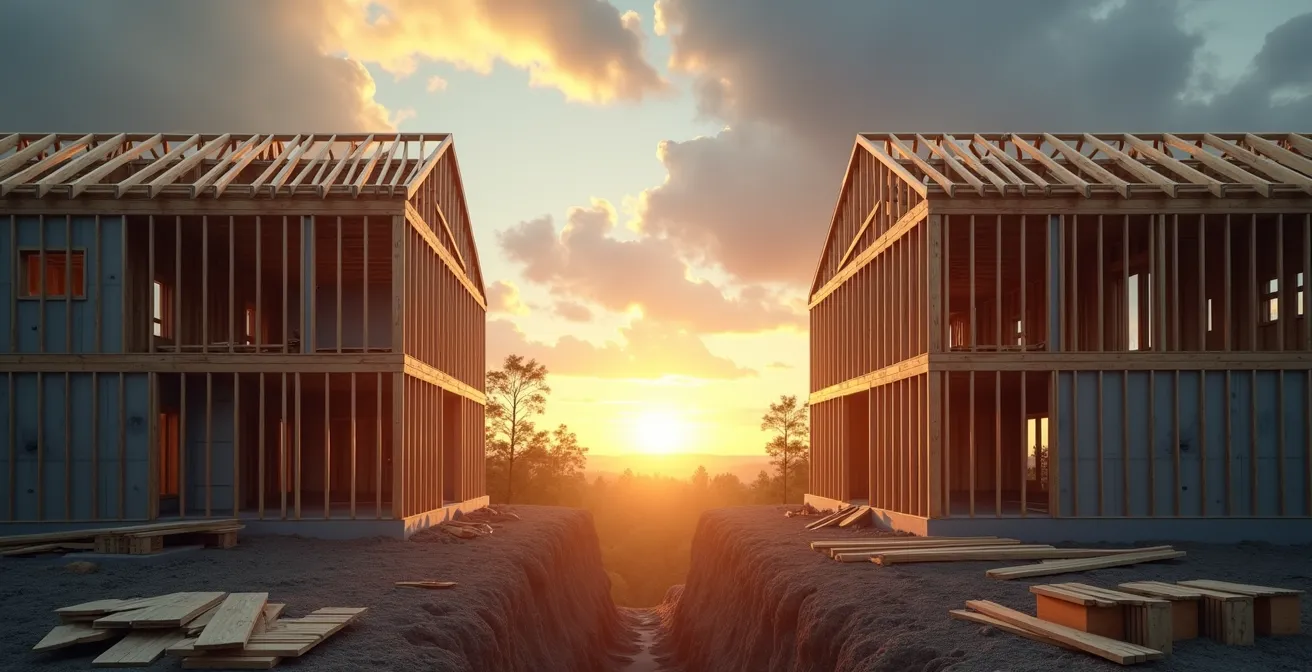
When your insurance settlement falls short of rebuilding costs, the key is to shift from victim to project manager by applying a financial triage framework.
- Identify the three main causes of a funding gap: construction inflation, mandatory code upgrades, and hidden policy clauses.
- Strategically layer different funding sources—disaster loans, grants, and bridge loans—to cover the deficit.
Recommendation: Prioritize structural integrity and essential systems first, treating cosmetic finishes as secondary budget items you can delay.
The moment you receive the final settlement from your insurance company should be a moment of relief. But for a growing number of homeowners recovering from a catastrophic loss, it’s a moment of dawning horror. The check in your hand is nowhere near enough to rebuild the home you lost. This gap—the reconstruction deficit—is not just a minor inconvenience; it’s a financial crisis that can halt your recovery indefinitely. Most advice focuses on preventative measures like annual policy reviews, which is useless when your home is already a pile of rubble.
The standard recommendation to simply get “replacement cost value” coverage often fails to account for the brutal realities of the post-disaster economy. Surging demand for materials, a shortage of skilled labor, and mandatory building code updates create a perfect storm of unexpected expenses. You’re not just rebuilding a house; you’re competing for scarce resources in a high-cost environment, and your five-year-old policy was never designed to win that battle. The problem isn’t that you were necessarily underinsured, but that the financial landscape shifted dramatically beneath your feet.
This is where the mindset must shift from passive policyholder to active financial strategist. The key is not to lament the shortfall but to manage it with a clear-eyed system of financial triage. This guide provides that system. We will dissect the anatomy of the reconstruction deficit, from the slow poison of inflation to the sudden shock of unfunded mandates. More importantly, we will lay out a practical framework for prioritizing expenses, securing supplemental funding, and making the tough decisions that will get your family back into a safe, functional home without going broke.
To navigate this complex financial challenge, it is essential to understand each component of the problem and its corresponding solution. This article breaks down the key issues you will face and provides a strategic roadmap for bridging the gap between your insurance payout and the reality of rebuilding.
Summary: A Financial Triage Guide to Bridge the Reconstruction Deficit
- Why Inflation Creates a Massive Gap in Your Coverage After 5 Years?
- How to Secure a Bridge Loan to Finish Your Home Reconstruction?
- Standard vs Upgrade: Which Finishes Should You Sacrifice to Stay on Budget?
- The “Ordinance or Law” Gap That Leaves You Paying for Mandatory Upgrades
- What to Fix First When You Don’t Have Enough Money for Everything?
- The Co-Insurance Clause Trap That Reduces Your Payout by 30%
- How to Close the Gap Between Rebuilding Costs and New Building Codes?
- What Happens When You Face a Catastrophic Structural Loss of 100%?
Why Inflation Creates a Massive Gap in Your Coverage After 5 Years?
The dwelling coverage on your policy, which seemed adequate when you signed up, becomes a lagging indicator of real-world costs over time. The primary culprit is construction cost inflation, which consistently outpaces standard inflation. This isn’t just about the price of lumber; it includes labor, permits, machinery, and transportation. A policy that hasn’t been aggressively updated can quickly fall behind, leaving you significantly exposed after only a few years.
This gap isn’t a small discrepancy; it can be enormous. An analysis from Great American Insurance Group reveals the stark reality: a policy can become undervalued by 22% after just five years, assuming a 4% annual inflation rate in construction costs. If your home was insured for $500,000, this “inflationary deficit” means you could be facing a $110,000 shortfall before you even hammer the first nail. This is a silent erosion of your financial safety net.
This problem is compounded in the chaotic aftermath of a widespread disaster. A sudden surge in demand for materials and a limited pool of qualified contractors creates a localized micro-economy where prices skyrocket. This “demand surge” can add another 15-20% to rebuilding costs on top of baseline inflation. Your policy’s inflation guard endorsement, if you have one, is often capped at a low single-digit percentage and is simply no match for this post-disaster economic shock.
How to Secure a Bridge Loan to Finish Your Home Reconstruction?
When the insurance settlement is confirmed but the funds won’t cover the entire project, a bridge loan becomes a critical financial tool. This short-term loan is designed to “bridge” the gap between your immediate construction costs and the arrangement of a more permanent financing solution, such as a home equity loan or a refinance once the house is rebuilt and has value again. Lenders, however, see post-disaster loans as high-risk, so your application must be airtight.
Success hinges on presenting yourself not as a victim, but as the manager of a well-defined construction project. Your goal is to de-risk the loan for the lender by providing overwhelming evidence of a clear plan and a guaranteed exit strategy. This means having your full insurance settlement documentation, multiple fixed-price bids from vetted contractors, and a detailed construction timeline with clear milestones. For example, showing a lender a signed $400,000 insurance settlement and a fixed-price contractor bid for a $480,000 rebuild makes the $80,000 funding need tangible and justifiable.
Your loan package should also include a pre-loss appraisal of your property to establish its former value and documentation for your exit strategy. This could be a pre-qualification letter for a mortgage refinance that will pay off the bridge loan upon the project’s completion. A public adjuster can be instrumental in this phase by helping you organize the claim documentation in a way that is clear and compelling to financial institutions. You are essentially building a business case for your home’s reconstruction, and meticulous documentation is your greatest asset.
Standard vs Upgrade: Which Finishes Should You Sacrifice to Stay on Budget?
Facing a reconstruction deficit forces you to make difficult choices. This is the heart of financial triage: separating the essential from the desirable. The goal is to allocate your limited funds to the elements that ensure the home is structurally sound, safe, and functional. Everything else becomes a “sacrificial finish”—an item you can downgrade or postpone to protect the core budget. This strategic sacrifice is not about giving up; it’s about smart phasing.
To implement this, think of your home in three tiers of priority. The visual below helps frame this hierarchy, moving from the non-negotiable foundation to the easily upgradeable cosmetic touches.
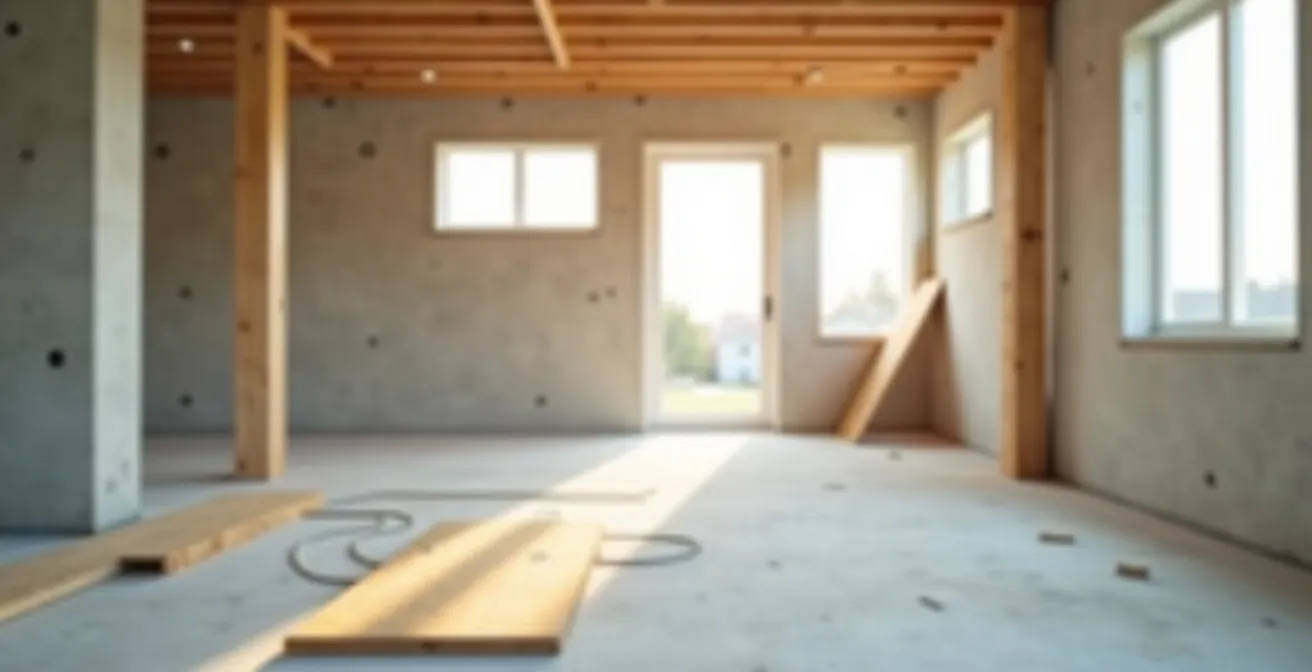
Tier 1, the structural core, is non-negotiable: foundation, framing, roofing, and the exterior envelope. Tier 2 includes essential systems like plumbing, electrical, and HVAC. Tier 3 is where the sacrifices are made: high-end appliances, custom cabinetry, expensive flooring, and luxury fixtures. You might opt for quality laminate flooring now instead of hardwood, or mid-range appliances instead of commercial-grade ones, with the plan to upgrade in 5-7 years.
Making these decisions requires a clear understanding of cost versus long-term value. Some “upgrades” are actually smart investments, while others offer poor returns. The following table breaks down the financial impact of common material choices, helping you prioritize where to spend and where to save.
| Finish Category | Budget Option | Premium Option | Cost Difference | Resale Impact |
|---|---|---|---|---|
| Appliances | Mid-range reliable brands | Ultra-luxury brands | $15,000-30,000 | Minimal |
| Windows | Standard double-pane | Triple-pane high-efficiency | $10,000-20,000 | Significant |
| Flooring | Quality laminate | Hardwood | $8,000-15,000 | Moderate |
| Insulation | Code minimum | High-performance | $5,000-10,000 | High (energy savings) |
As the data shows, sacrificing ultra-luxury appliances saves a significant amount with minimal impact on resale value, whereas investing in high-performance windows or insulation offers a much higher long-term return through energy savings. This is data-driven triage.
The “Ordinance or Law” Gap That Leaves You Paying for Mandatory Upgrades
One of the most shocking discoveries for homeowners is that a standard policy is designed to rebuild your old house, not the new house the law now requires. Building codes evolve constantly to improve safety and energy efficiency. If your home was built 20 years ago, it’s virtually guaranteed that it doesn’t meet today’s standards. After a major loss, you aren’t allowed to rebuild it “as it was”; you must build to current code, and the cost of these mandatory upgrades can be staggering.
Unless you have a specific “Ordinance or Law” endorsement on your policy, this entire financial burden falls on you. This isn’t a small expense; sources like Banas Insurance note that code compliance can add tens of thousands of dollars to a rebuild. This unfunded liability, which I call “code compliance debt,” can single-handedly create a massive reconstruction deficit. The older your home, the larger this debt is likely to be.
The costs come from requirements you would never anticipate. Many jurisdictions now mandate expensive upgrades that were unheard of when your home was built. These can include:
- Mandatory fire sprinkler system installation (which can add 15-20% to the total rebuild cost)
- Forced conversion from a septic to a sewer system (costing $20,000-$50,000)
- Updated seismic reinforcement requirements in earthquake-prone areas (a 10-25% cost increase)
- New standards for electrical panels and wiring to handle modern loads ($5,000-$15,000)
- Hurricane-resistant windows and roofing in coastal areas (a 20-30% cost increase)
Your standard dwelling coverage was never intended to pay for these items, creating a gap that must be filled out-of-pocket or with supplemental financing.
What to Fix First When You Don’t Have Enough Money for Everything?
When the budget is tight, every dollar must be directed with surgical precision. The “financial triage” approach becomes a literal construction sequence. You must adopt the Critical Path Method, focusing exclusively on what makes the home safe and habitable. This means restoring the home’s essential functions in a logical order, leaving all cosmetic work for a later phase when finances have stabilized.
The absolute priority is to create a “dry-in” state. This means securing the structure from any further damage from the elements. This includes the foundation, load-bearing walls, sheathing, roofing, and the installation of windows and doors. Once the exterior envelope is secure, you move to the critical systems that support life: water, power, and HVAC. Only when the house is a protected, climate-controlled space with functioning utilities can you begin to think about interior walls and basic finishes.
This phased approach allows you to reach a state of habitability faster, even if the home is not “finished” in the traditional sense. You might live with concrete floors and unpainted drywall in some rooms for a year, but you will have a safe and functional shelter. This strategy is especially critical in high-cost construction states where even moderate underinsurance can lead to six-figure shortfalls. This methodical approach gives you control in a chaotic situation.
Your Action Plan: The Critical Path for Rebuilding on a Budget
- Secure from further damage: Immediately tarp damaged roofs and board up openings to prevent weather-related deterioration.
- Restore critical systems for habitability: Prioritize the repair and certification of water, power, and HVAC systems.
- Rebuild the exterior envelope: Focus all initial funds on completing the roof, walls, and windows to create a secure, weatherproof shell.
- Complete structural repairs: Ensure the foundation, framing, and all load-bearing elements are fully repaired and inspected before any interior work begins.
- Finish interior spaces in phases: Complete essential areas like one bathroom and a kitchen first. Leave basements or spare bedrooms as unfinished shells to be completed as budget allows.
The Co-Insurance Clause Trap That Reduces Your Payout by 30%
Even if you’ve done everything right so far, there may be a devastating trap hidden in the fine print of your policy: the co-insurance clause. This is one of the most misunderstood and financially dangerous aspects of a homeowners policy. In simple terms, it’s a requirement that you insure your home for a certain percentage of its total replacement cost (usually 80% or 90%). If, at the time of loss, your coverage amount is found to be below this threshold, the insurance company can impose a significant penalty, drastically reducing your payout.
Here’s how the trap springs. Let’s say your home’s true replacement cost is $500,000 and you have an 80% co-insurance clause. This means you must carry at least $400,000 in dwelling coverage. Now, imagine due to inflation and rising construction costs, your coverage has slipped to just $350,000. You are now underinsured according to the clause. If you then suffer a $200,000 partial loss (e.g., a major fire that destroys half the house), the insurer won’t just pay you $200,000. They will calculate a penalty.
The penalty formula is typically: (Amount of Insurance Carried / Amount of Insurance Required) x Amount of Loss = Payout. In our example, it would be ($350,000 / $400,000) x $200,000 = $175,000. You would be penalized $25,000 simply because your overall coverage limit had not kept pace with replacement costs. This is how a homeowner who thought they were covered for a $200,000 loss suddenly has to come up with an extra $25,000. It is crucial to distinguish replacement cost (what it costs to build) from market value (what it costs to buy, including land). Your policy limit must reflect the former, not the latter.
How to Close the Gap Between Rebuilding Costs and New Building Codes?
The “code compliance debt” we discussed earlier can feel like an insurmountable, unfunded mandate. However, you are not entirely without resources. Closing this specific gap requires a proactive strategy of “funding stacking,” where you layer various specialized sources of capital on top of your base insurance payout. This approach treats the rebuild not as a single transaction but as a multi-faceted financial project.
Your base insurance payout is Layer 1, intended for a “like-for-like” rebuild. The deficit created by code upgrades must be filled by other layers. Layer 2 is often a low-interest disaster loan from a government agency like the Small Business Administration (SBA) in the U.S., which offers loans specifically to bring a property up to current code. Layer 3 can come from green energy grants for installing high-efficiency HVAC, solar systems, or better insulation—upgrades that are often mandated by new codes anyway. Many states and utility companies offer these incentives.
Further layers can be found in specialized programs. For example, some regions offer resilience grants (Layer 4) for using stronger, disaster-resistant materials that exceed the base code. Finally, local utility rebates (Layer 5) can help offset the cost of energy-efficient windows and appliances. This stacking strategy transforms a single, massive problem into five smaller, more manageable funding challenges. It requires research and paperwork, but it’s the most effective way to finance mandatory upgrades without depleting your personal savings. This is further complicated by the fact that policy coverage is not keeping up, as data shows a widening value gap where premiums rise much faster than the actual coverage they provide.
Key Takeaways
- The reconstruction deficit is a predictable crisis caused by inflation, code changes, and policy limits, not a random stroke of bad luck.
- Adopt a “financial triage” mindset: prioritize structural safety and essential systems over cosmetic finishes to control the budget.
- Actively build a “funding stack” by layering disaster loans, grants, and rebates on top of your insurance payout to cover mandatory upgrades.
What Happens When You Face a Catastrophic Structural Loss of 100%?
A 100% structural loss is the ultimate test of your financial preparedness. This is where all the potential gaps—inflation, code compliance, co-insurance penalties—converge into a single, massive reconstruction deficit. The raw, emotional reality of this situation was captured by one homeowner who, after a fire, was told her policy would only cover what the house *used* to cost, not what it would cost to rebuild.
An American woman loses her home in a fire. She asks insurance to rebuild the SAME home—no upgrades, no expansion. Insurance says NO. Her policy only covers what the house USED to cost. When disaster hits, homeowners learn what their policy actually promised. This brings us to a recent video a woman posted after her house burned down, explaining that despite having insurance, she was told she couldn’t rebuild what she lost, exposing the clear gap between the insurance many of us think we have and the reality.
– Cypher-News
In this total loss scenario, the numbers become brutally simple. If your coverage is $400,000 but the true, all-in cost to rebuild to today’s standards is $550,000, you have a $150,000 deficit. This gap is exacerbated by external factors beyond your control. For example, a severe construction labor shortage, with a deficit of over 500,000 workers, drives bid prices through the roof just when you need help the most. When facing a total loss, you must immediately deploy every strategy discussed: secure a bridge loan, apply for all eligible grants and disaster loans, and ruthlessly apply the principles of financial triage to your new home’s design.
This is the moment of truth where you must decide: rebuild smaller, accept a significant downgrade in finishes, or commit to a multi-year plan of phased construction. The key is to make this choice proactively. By understanding the full anatomy of the reconstruction deficit, you can create a realistic plan that puts you back in control of your recovery, even when faced with the worst-case scenario.
To put these strategies into practice, your immediate next step is to get multiple, fixed-price bids from vetted local contractors. This will transform your estimated deficit into a hard number, which is the foundational data point for building your funding stack and starting your financial recovery.